


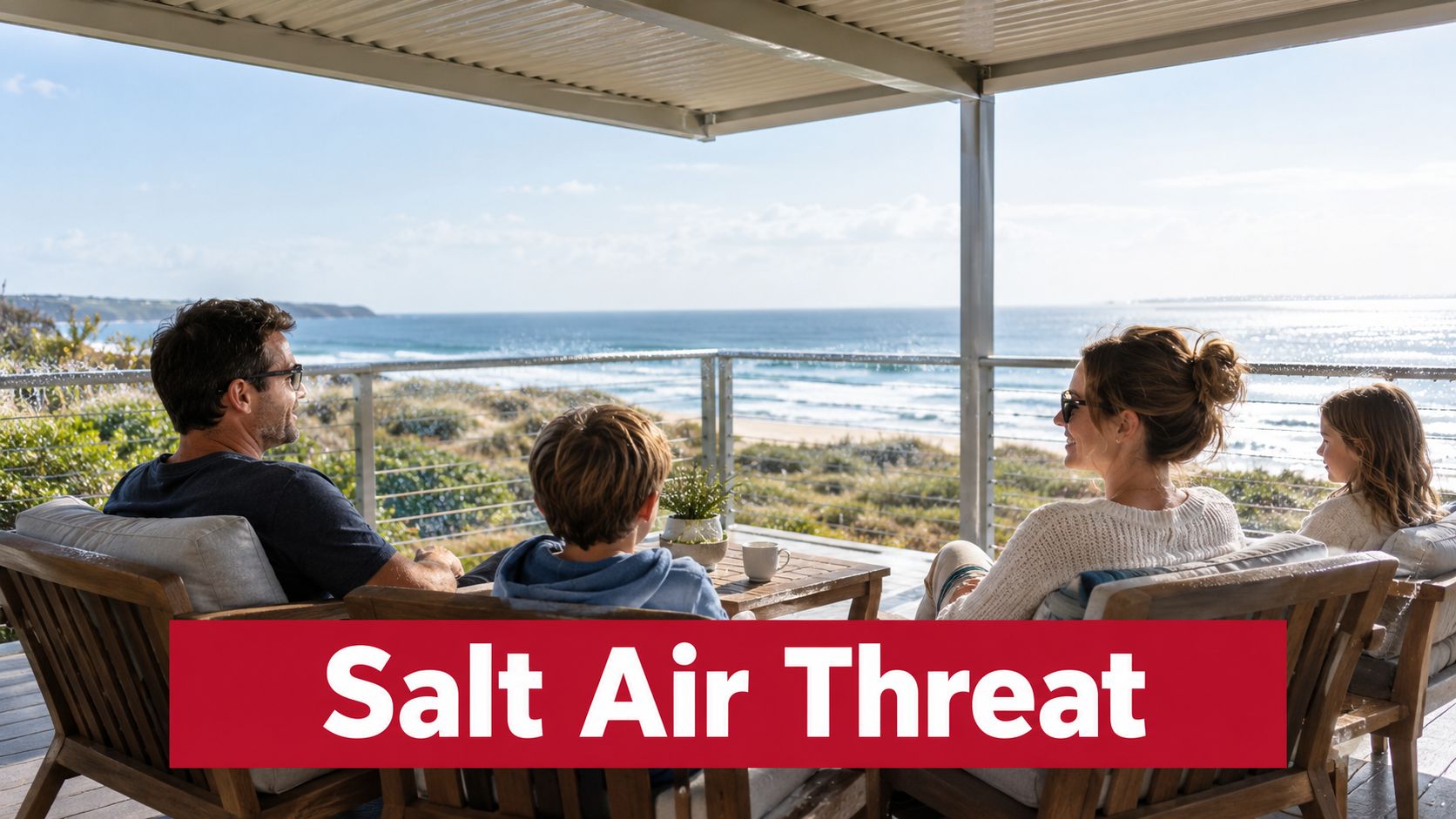
Imagine pulling up a chair under a covered patio in Wamberal, Terrigal or Bateau Bay on a warm Saturday afternoon. The barbecue is going, the louvres are open and the family can finally enjoy the garden without watching the weather. A sea breeze feels welcome, but the same breeze can carry fine salt onto roof sheets, brackets, fasteners and concealed joints.
Salt air corrosion protection isn't a simple matter of choosing a product labelled “marine grade”. The result depends on the site's microclimate, the way the structure is detailed, the compatibility of its metals and the maintenance carried out after installation. A well-designed pergola, carport, verandah or outdoor blind can cope with Central Coast conditions, but only when the entire system is specified and cared for as one.
Custom Stratco patio designs for the Central Coast should therefore begin with an exposure assessment, not a guess based on postcode or distance to the beach.
Table of Contents
- Why Salt Air Is the Silent Threat to Coastal Outdoor Living
- How Salt Air Corrosion Works
- Why Distance from the Ocean Is the Wrong Rule
- Choosing Materials, Coatings and Fasteners for the Coast
- Design Details That Stop Salt Air in Its Tracks
- A Realistic Maintenance Rhythm for Coastal Structures
- What Fails First and What Lasts on the Central Coast
- The Short Answer, Pricing Guide, FAQs and Next Steps
Why Salt Air Is the Silent Threat to Coastal Outdoor Living
At a home near Wamberal or Forresters Beach, salt may settle on a roof while the surface still looks clean. Overnight humidity keeps the deposit active, then morning warmth dries the metal and concentrates the remaining salts. The first damage often begins at a bolt head, a weld, a drilled hole, a cut edge or the underside of a beam where rain doesn't wash the surface properly.
Wind, sun and heavy rain are obvious hazards. Homeowners see a loose sheet after a storm or faded colour after years of summer exposure. Salt air behaves differently. It can start a corrosion cycle without a dramatic event, then remain unnoticed until a coating blisters, a fastener pits or red rust appears below a joint.
Why concealed areas deserve attention
Chloride from ocean surf travels in salt-laden moisture. It settles unevenly, so a structure doesn't have one consistent exposure level. A high, open carport may receive more airborne salt than a sheltered patio, while a covered gutter or screen channel may retain deposits for longer because it receives little fresh-water rinsing.
The most vulnerable locations commonly include:
- Cut edges and drilled holes, where the factory coating has been interrupted.
- Laps and penetrations, where salt and moisture can remain trapped.
- Fastener interfaces, especially where dissimilar metals touch.
- Undersides and horizontal ledges, which receive less natural washing.
- Timber-to-metal brackets, where damp debris can sit against a connection.
Practical rule: A coastal structure lasts through a combination of suitable materials, careful detailing and regular removal of salt. No single premium finish can repair a poorly drained joint.
The relevant question for a Central Coast homeowner is whether a structure is coastal. It is how the structure faces the wind, where water collects and whether the chosen system can be inspected and maintained. That approach supports weekend entertaining now and avoids turning a small coating defect into a larger structural repair later.
How Salt Air Corrosion Works
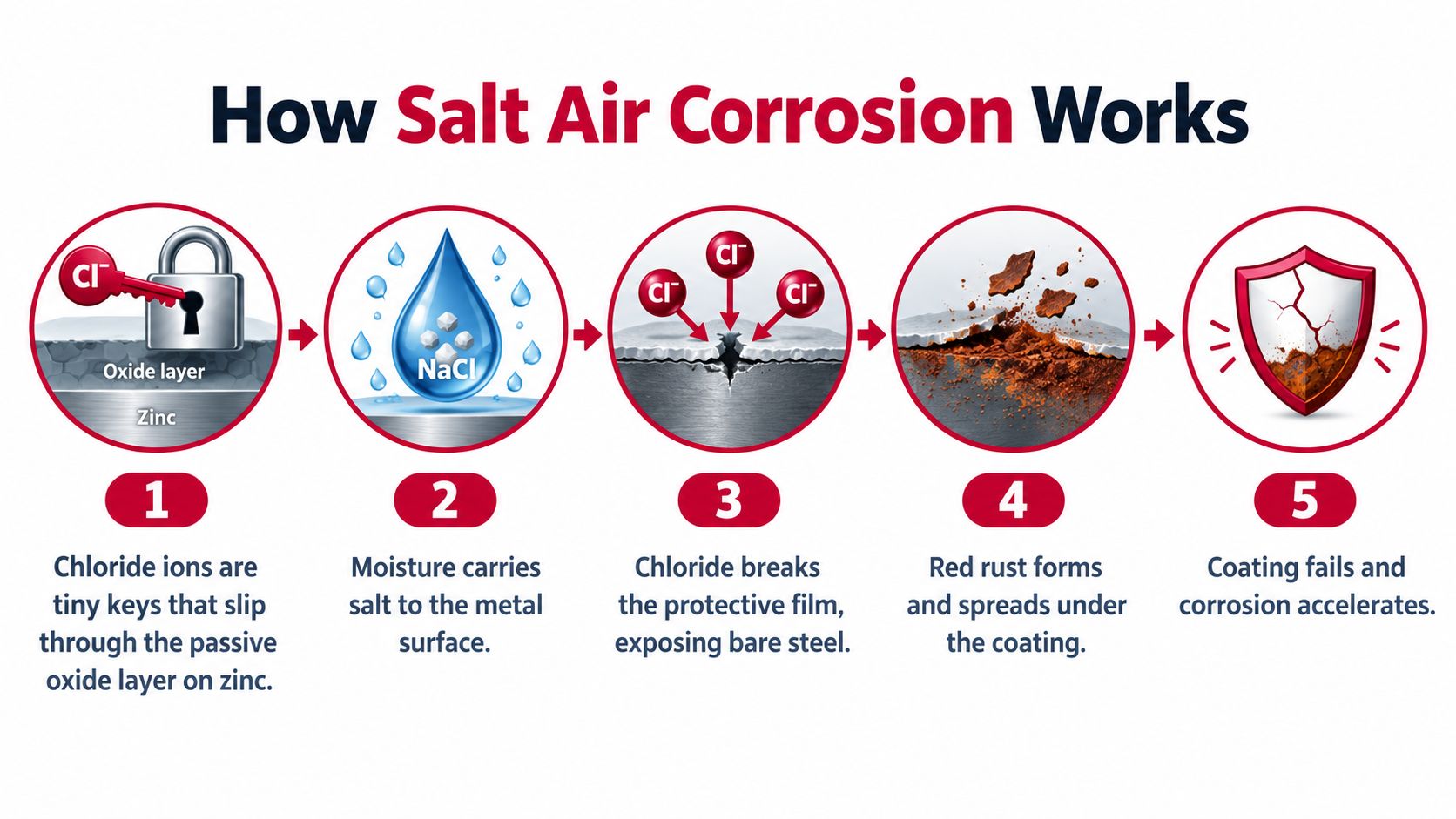
A patio near the Central Coast can start corroding in places that look protected. Metal corrosion needs a surface, moisture and an electrolyte. Salt makes that moisture more aggressive. When chloride deposits remain wet on steel or zinc-coated steel, they help form an electrolyte that speeds metal dissolution and encourages localised attack around scratches, edges, crevices and joints. The mechanism is explained in Australian guidance on atmospheric corrosivity assessment under AS 4312.
Protective oxide and coating layers act like a locked door. Small chloride ions reach weak points in that protection. With moisture and oxygen present, exposed metal begins an electrolytic reaction. On a pergola or patio roof, corrosion may start beneath a fastener washer, inside a cut section or at a connection before it is visible from the ground.
Wet and dry cycles create hidden risk
A permanently submerged object experiences a different corrosion environment from a structure repeatedly exposed to wetting and drying. On an outdoor roof, awning or pergola, salt arrives during damp weather, remains active while the surface is humid, then becomes more concentrated as water evaporates. The next damp period reactivates the deposit.
Sheltered areas can therefore deserve closer attention than exposed faces. Rain may rinse the top of a beam, while its underside, gutter fold or screen track holds salt and leaf debris. The surface can appear dry while chloride retains enough moisture to continue attacking the metal between rain events.
That pattern affects how a homeowner should specify and maintain an outdoor living structure. A coating suited to the general region may still fail early if a joint repeatedly traps salty moisture. Inspection needs to focus on where deposits stay active, not just on the broad material grade.
AS 4312 gives the assessment a common language
AS 4312 uses atmospheric corrosivity categories based on the annual corrosion rate of mild steel:
| Category | Mild-steel corrosion rate |
|---|---|
| C3 | 25–50 µm/year |
| C4 | 50–80 µm/year |
| C5 | 80–200 µm/year |
| CX | 200–700 µm/year |
These figures and the category framework come from AS 4312. A sheltered Central Coast site may need a different specification from an exposed surf-facing site, even when both homes are in the same broad region. The category should inform the coating system, fasteners, cut-edge treatment and inspection routine.
The Australian Steel Institute identifies ocean surf as the major source of chloride responsible for metal corrosion in Australia. Its guidance on assessing atmospheric corrosivity supports assessing breaking surf and prevailing wind exposure rather than applying one generic coastal label.
For handrails and balustrade components, this resource on choosing corrosion-resistant railing materials explains why material choice and surface exposure must be considered together.
Why Distance from the Ocean Is the Wrong Rule
A straight-line measurement to the beach is a useful starting point, but it isn't a complete corrosion assessment. Australian guidance indicates that marine exposure may extend roughly 1 to 10 kilometres inland from oceanfront areas with breaking surf and significant salt spray, and favourable wind and terrain can carry the influence to about 50 kilometres inland. The Australian galvanising guidance on coastal environments explains why distance alone can mislead.
Consider two hypothetical Central Coast homes. One may sit inland behind dunes, headlands, vegetation and neighbouring buildings. Another may be closer to calm water but occupy a raised ridgeline that catches unbroken onshore wind. The second structure could receive more salt deposition even though the postcode or shoreline measurement suggests otherwise.
What changes the exposure
A site assessment should record:
- Wind direction and openness, including whether the roof faces prevailing sea winds.
- Surf conditions, because breaking surf generates chloride-laden spray.
- Elevation and terrain, particularly ridgelines and exposed slopes.
- Shelter, including dunes, buildings, vegetation and landform.
- Surface dampness, including areas that remain shaded or poorly ventilated.
- Rain washing, which varies between exposed faces and sheltered recesses.
- Nearby waterways or wetlands, where humidity can affect the local environment.
A patio in Erina or Wyong isn't automatically low risk, and a structure in Killcare Heights isn't defined by distance alone. A lakeside block can have a different combination of humidity, wind and shelter from an open oceanfront block. The same principle applies in Gosford, Toukley and Terrigal.
The strongest specification records the site's direction from surf, prevailing-wind exposure, roof geometry, drainage and salt-collecting details. It then selects the corrosivity category and compatible materials from that evidence. A generic promise that a structure is suitable “within one kilometre of the ocean” doesn't tell a homeowner enough about the actual microclimate.
Choosing Materials, Coatings and Fasteners for the Coast
Material selection is a system decision. Aluminium, galvanised steel, aluminium-zinc coated steel, stainless steel and timber each have useful applications, but none removes the need for sound drainage and compatible fixings.
Aluminium can be a practical framing choice in higher exposure locations when the alloy, conversion treatment and powder-coat system suit the environment. Stainless steel fasteners, particularly where the structure is close to surf, need to match the exposure and the surrounding materials. Galvanised steel remains useful in more sheltered conditions, but field cuts, welds and drilled edges need proper protection rather than a quick coat of ordinary primer.
Powder coating provides a durable finished surface when the substrate preparation and application are correct. More demanding environments may call for a higher-performance coating system, such as a fluoropolymer finish, where the design and product supplier support that choice. Anodising can also suit some aluminium components, although the final decision should account for colour, appearance, edges, fixings and cleaning access.
The small interfaces cause large problems
Dissimilar metals can create galvanic problems when moisture and salt connect them. Isolation gaskets, EPDM strips, suitable washers and compatible sealants reduce direct contact. A stainless fastener isn't automatically a complete solution if it sits against an unprotected cut edge or traps water beneath its washer.
For decks, the choice between timber and composite boards brings separate considerations around movement, cleaning, fastener detail and the way the deck meets metal posts or brackets. A comparison of timber and composite decking for Central Coast homes can help homeowners assess the whole outdoor area rather than focusing only on the roof.
| Material / component | C3, sheltered | C4, exposed or surf-zone edge | C5 / C5-M, direct spray |
|---|---|---|---|
| Aluminium framing | Suitable with an appropriate finish and drainage | Specify a coastal-suitable finish and isolate dissimilar metals | Use a system selected for the assessed exposure, with careful fastener and cut-edge detailing |
| Galvanised steel | Useful where the coating and detailing match the site | Increase protection and seal exposed cuts | Don't rely on ordinary galvanising alone without a site-specific protective system |
| Aluminium-zinc coated steel | Suitable when product guidance supports the environment | Protect cuts, penetrations and laps | Confirm the manufacturer's coastal limitations and maintenance requirements |
| Stainless fasteners | Match the fastener to the surrounding metals | Use corrosion-resistant fixings and isolation details | Select fixings for direct marine exposure and prevent crevice water |
| Timber posts and framing | Keep end grain and brackets dry | Provide ventilation and separation from damp metal | Treat connections and moisture paths as carefully as the timber itself |
For anyone checking fastener compatibility, this rustproof deck hardware guide 2026 provides additional background on corrosion-resistant hardware. The essential trade-off is straightforward. Spending more on a fastener won't compensate for trapped water, but choosing a cheap fastener can undermine an otherwise suitable coating system.
Design Details That Stop Salt Air in Its Tracks
A good specification can still fail if the water management is poor. Salt-laden moisture becomes more damaging when a roof fold, flat ledge, flashing lap or bracket pocket gives it somewhere to sit.
Make water leave quickly
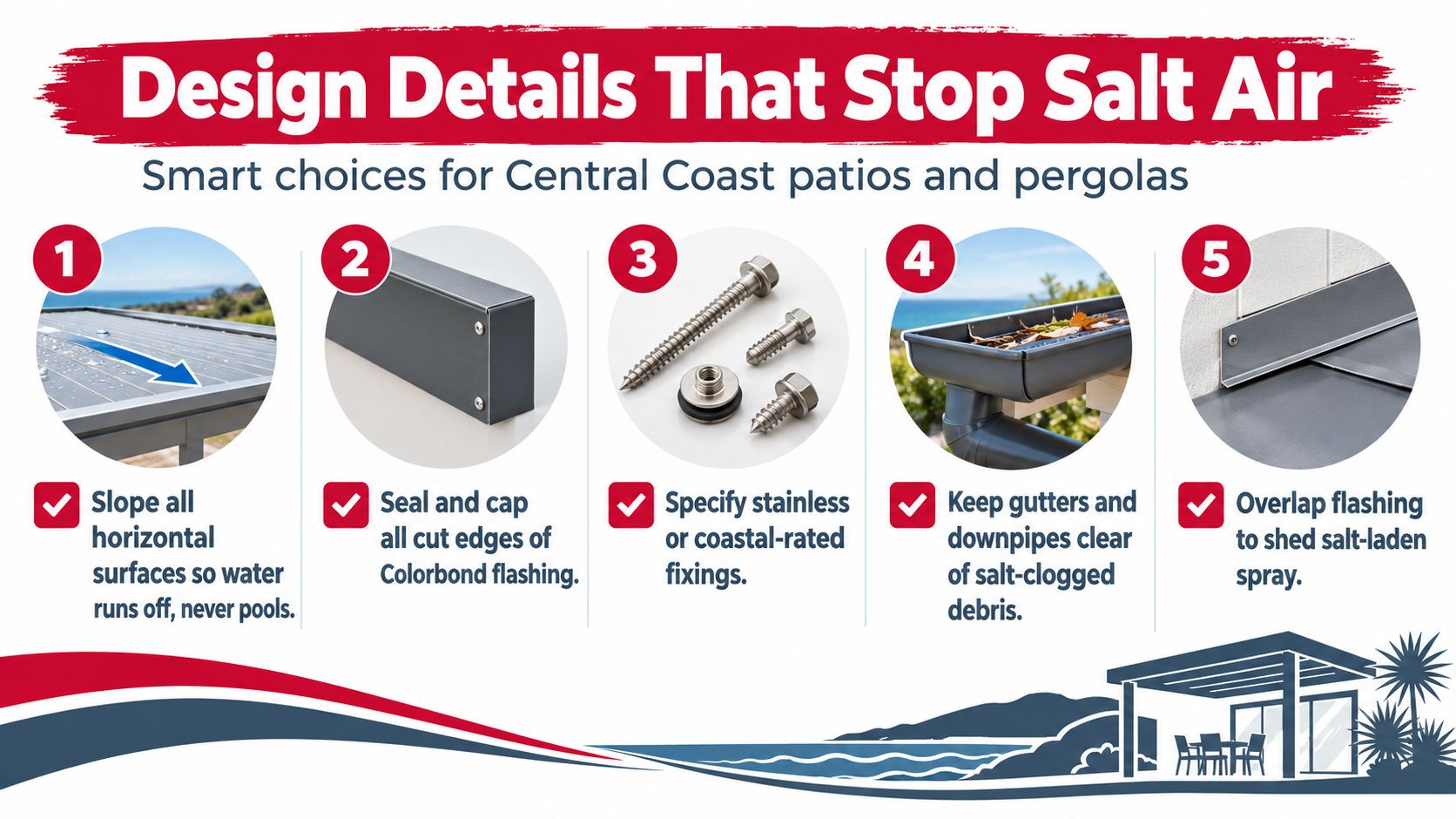
Roof geometry should shed rain and spray rather than create shallow ponds. Drip edges and sensible overhangs throw water clear of posts and beams. End caps and flashings keep salt from entering hollow sections, while open, ventilated details allow damp areas to dry.
The design should avoid unnecessary horizontal ledges. Where a ledge is unavoidable, it needs a fall, a cleanable edge and a detail that doesn't hold debris. Gutter outlets and downpipes also need enough access for inspection, because salt mixed with leaves creates a damp paste that can remain against coated metal.
Protect the interrupted surfaces
Every field cut, drilled hole and weld interrupts the original protection. A competent installer treats those areas with the specified zinc-rich or compatible repair coating, seals the detail and checks that the repair bonds correctly. Neutral-cure silicone around suitable penetrations can prevent water entry, but sealant isn't a substitute for correct flashing overlap or drainage.
Fasteners should be isolated where required with EPDM or nylon washers, gaskets or strips. Screening also needs a ventilation gap behind it, particularly on a north-facing or wind-exposed side where warm, damp air can otherwise remain trapped.
Installer question: Ask how field cuts, drilled holes, welds, penetrations and dissimilar-metal interfaces will be treated before the structure is ordered.
The roof profile and drainage plan deserve the same attention as the visible colour. Homeowners comparing options can review patio roof types for Central Coast conditions before choosing between a flat, gable, flyover or insulated roof arrangement.
A Realistic Maintenance Rhythm for Coastal Structures
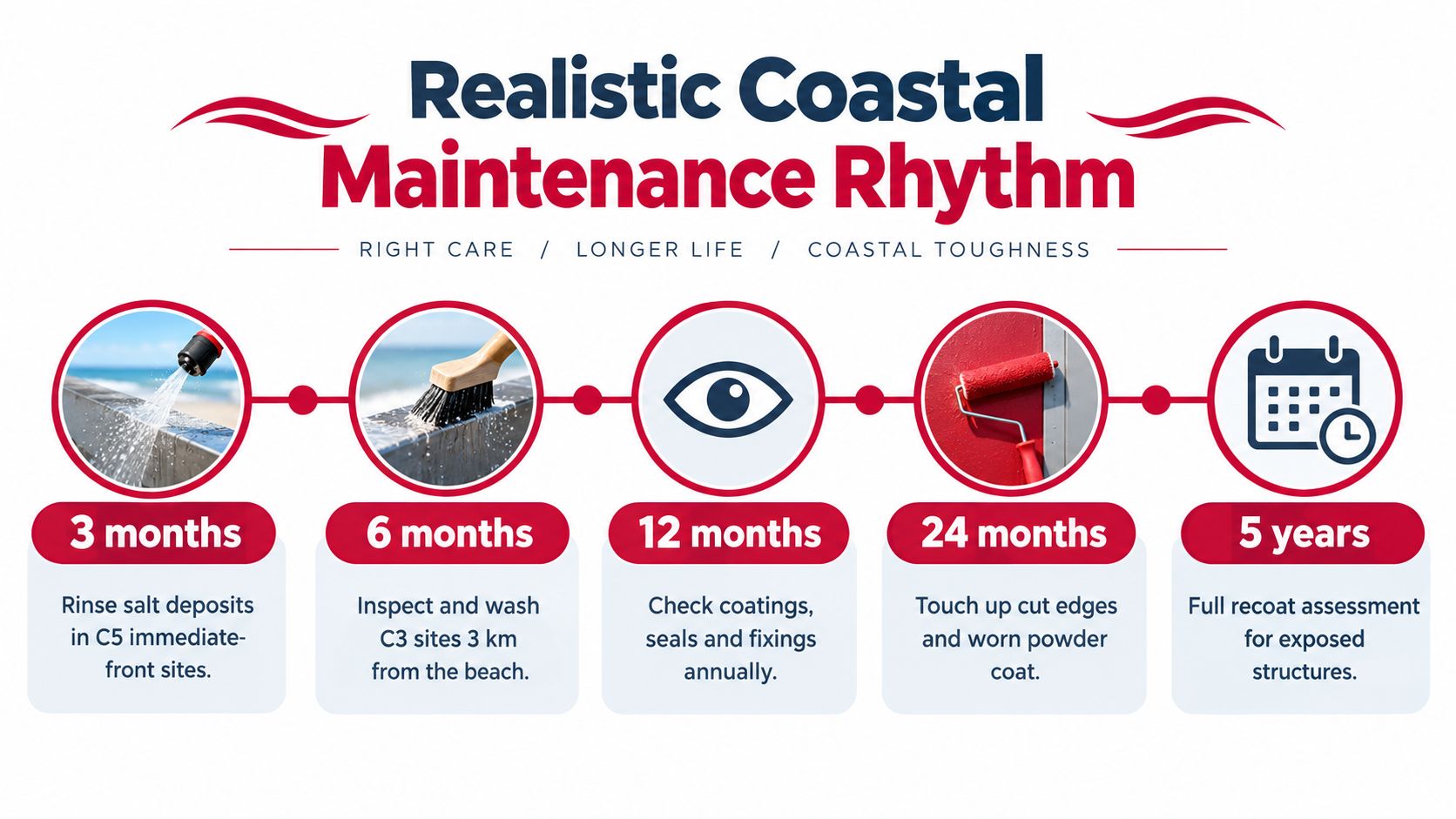
Maintenance should follow exposure, not a universal calendar. A sheltered C3 site may need less frequent rinsing than a structure in direct view of breaking surf, while a covered underside may need closer inspection than a roof plane that receives regular rain washing.
Routine cleaning means a low-pressure fresh-water rinse, followed where necessary by a soft brush and pH-neutral wash. The purpose is to remove chloride, leaf debris and grime from beam-to-post joins, gutters, blind hardware, screen channels, laps and fastener interfaces. A pressure washer can damage or lift a powder-coated finish, force water into joints and make a small defect harder to see.
What an inspection should find early
Look closely for:
- White salt blooms, particularly around sheltered joins and fastener heads.
- Tea staining on stainless steel, which indicates surface contamination or an unsuitable detail.
- Blistering, chalking or lifting, which may show that moisture has reached below a coating.
- Red oxide at cuts and welds, an early warning that exposed steel needs treatment.
- Blocked gutters and trapped leaves, which extend the time that salt and water remain together.
- Loose or damaged seals, where a small penetration can admit moisture repeatedly.
A C5 immediate-front site may need frequent rinsing during the warmer, drier part of the year, while a sheltered site further inland may be managed with a less frequent exposure-based plan. The correct interval should follow the assessed category, the manufacturer's instructions and the structure's actual condition.
Keep dated maintenance records, especially where a product warranty requires care in accordance with written instructions. Australian guidance stresses that humidity, rainfall, wind, wetlands, tidal waterways and industrial sources can all affect corrosion, so a fixed annual promise is weaker than a documented plan based on conditions.
Timber elements need their own inspection routine around end grain, brackets and moisture traps. Guidance on timber deck maintenance for coastal homes is useful when a deck sits below or beside a metal patio.
What Fails First and What Lasts on the Central Coast
On a neglected coastal pergola, failure rarely begins with the main beam. It often starts at the detail that was cut, drilled, joined or forgotten.
A cut edge on flashing can develop red rust before the broad coated surface looks damaged. A fastener can pit where it meets an aluminium purlin or where salt remains beneath its head. A hardwood post can deteriorate inside a bracket pocket when water and debris are allowed to sit against the end grain.
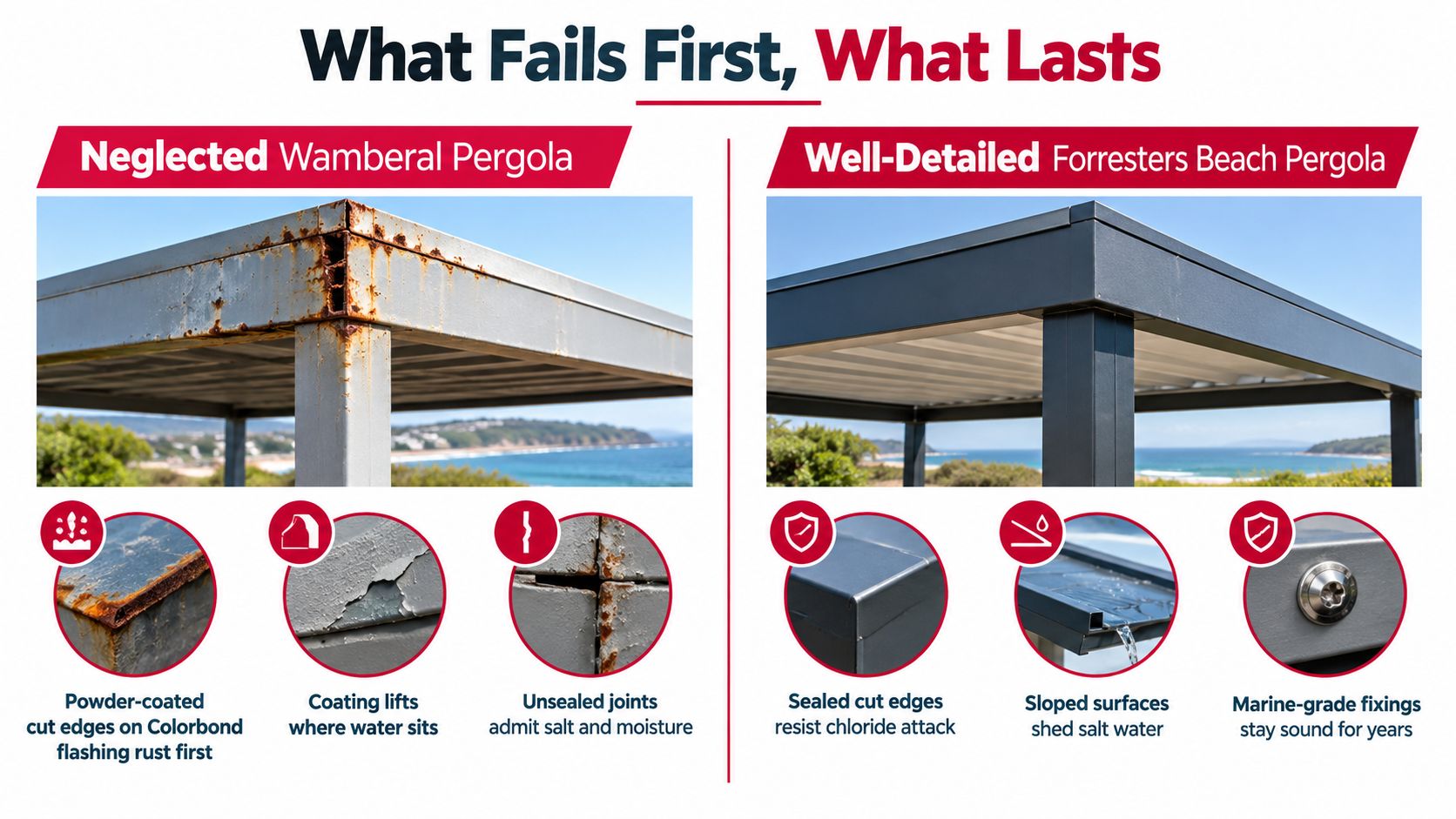
A well-detailed structure takes the opposite approach. The installer seals exposed cuts, uses compatible fixings, separates dissimilar metals and leaves water a clear path away from the connection. The owner rinses salt from exposed and sheltered surfaces, clears gutters and reports coating damage before corrosion spreads beneath the finish.
The system matters more than one premium component
A marine-suitable fastener cannot protect a neglected cut edge. A strong coating cannot overcome a flat ledge that holds salty water. A durable timber post still needs a bracket detail that keeps its end grain dry.
The same principles apply to a patio, carport, louvre roof, outdoor blind or generic aluminium slat privacy screen. The backyard deck ideas for Central Coast outdoor areas should be assessed alongside roof drainage, access for cleaning and the way each material meets the next.
The Short Answer, Pricing Guide, FAQs and Next Steps
The short answer
Assess the actual site corrosivity, specify coatings and fasteners to match it, detail every cut and joint so water drains away, then commit to freshwater rinsing and inspections that reflect the exposure. Distance from the ocean is only one clue. Microclimate and maintenance decide how the structure performs.
Coastal Outdoor Structure Pricing Guide, Central Coast NSW
There is no responsible fixed market figure without the structure size, roof style, materials, access, ground conditions, engineering and approval pathway. The guide below shows how specification affects the quote, without presenting invented amounts as Outdoor Leisure Living pricing.
| Structure type | Good, C3 spec | Better, C4 spec | Best, C4+ spec |
|---|---|---|---|
| Patio | Standard suitable system with sound drainage and protected cuts | More robust coating and fastener package for exposed sites | Site-specific marine exposure assessment, upgraded finishes and detailed maintenance plan |
| Pergola | Suitable framing, sealed joints and accessible drainage | Coastal-rated finish, isolated fixings and improved screening ventilation | Direct-spray specification with enhanced detailing, inspection access and documented care |
| Carport | Appropriate roof and frame system for a sheltered block | Higher exposure protection around posts, fixings and roof penetrations | Site-specific engineering and corrosion package for open, wind-facing locations |
The final cost depends on size, roof form, materials, site access, sloping or lakeside ground, council requirements and the assessed exposure. Pergola installation cost guidance for Central Coast homeowners can help with early budgeting, but a fixed-fee on-site quote is needed for a reliable figure. Interest-free finance may be available subject to current promotions.
Frequently asked questions
Does salt exposure cancel a structural warranty?
Not automatically. Warranty conditions usually depend on the specified product, installation, environment and maintenance. Keep the written warranty and dated cleaning records, and follow the manufacturer's instructions.
Is a home within one kilometre of the beach always a high-corrosion site?
No. Wind, surf, shelter, elevation, terrain, orientation and rain washing can change the exposure substantially. Distance is a starting point, not the complete assessment.
Does stainless steel eliminate corrosion?
No. Stainless can develop staining or pitting when chloride remains trapped, when the grade doesn't suit the environment or when incompatible metals create a poor interface. Cleaning and isolation still matter.
Can a damaged powder coat be painted over?
Small defects may be repairable, but the correct preparation and compatible repair coating matter. Red rust, blistering or corrosion beneath the finish should be assessed before a cosmetic touch-up.
Are DIY kits suitable for coastal structures?
A kit may not address a sloping block, approval pathway, wind exposure, drainage, cut-edge treatment or fastener compatibility. Professional design and installation make those site decisions visible before construction.
What approvals may be needed?
A project may fall under exempt development, complying development or a development application, depending on its design and site. Current requirements should be checked through the NSW Planning Portal and with the relevant local council. Central Coast and Lake Macquarie homeowners should confirm the rules applying to their property before ordering materials.
Outdoor Leisure Living is the Central Coast's authorised Stratco and Stratco Outback dealer: family owned, over a decade in business with more than 35 years of industry experience, and 75+ five-star reviews across the Central Coast and Lake Macquarie.
Outdoor Leisure Living assesses salt exposure, drainage, coatings, fixings and maintenance access as part of a custom outdoor structure design, with fixed-fee quotes and professional installation across the Central Coast. Visit Outdoor Leisure Living to arrange a free on-site consultation for a patio, pergola, carport, deck, outdoor blind or privacy screen suited to the block.
Book your free on-site design consultation. Call 0494 571 131.