



Imagine pulling up a chair under a custom patio in Terrigal, only to have the afternoon glare drive everyone back inside. A north-facing entertaining area can be beautifully warm in the morning, while salt air, humidity and a southerly wind make the same space uncomfortable later in the day. Outdoor blinds can help turn that exposed patio, verandah or carport-adjacent area into a more usable place for weekend meals, shade and all-weather entertaining.
A successful outdoor blinds installation starts before the first bracket is fixed. Product style, window coverage, wind exposure, mounting surfaces, council rules and BASIX shading requirements all affect the finished result. A quick kit purchase might look simple, but a Central Coast home often needs a more careful response to coastal conditions, sloping blocks and changing weather.
Table of Contents
- Why Outdoor Blinds Change How You Use Your Patio
- Choosing the Right Blind Style for Your Space
- Site Assessment and Measuring for a Clean Fit
- Council Approval and BASIX Shading Rules on the Central Coast
- Installation Steps From Pre-Drill to Weatherproofing
- Costs, Timelines and DIY Versus Professional Installation
- Maintenance, Troubleshooting and Warranty Handover
Why Outdoor Blinds Change How You Use Your Patio
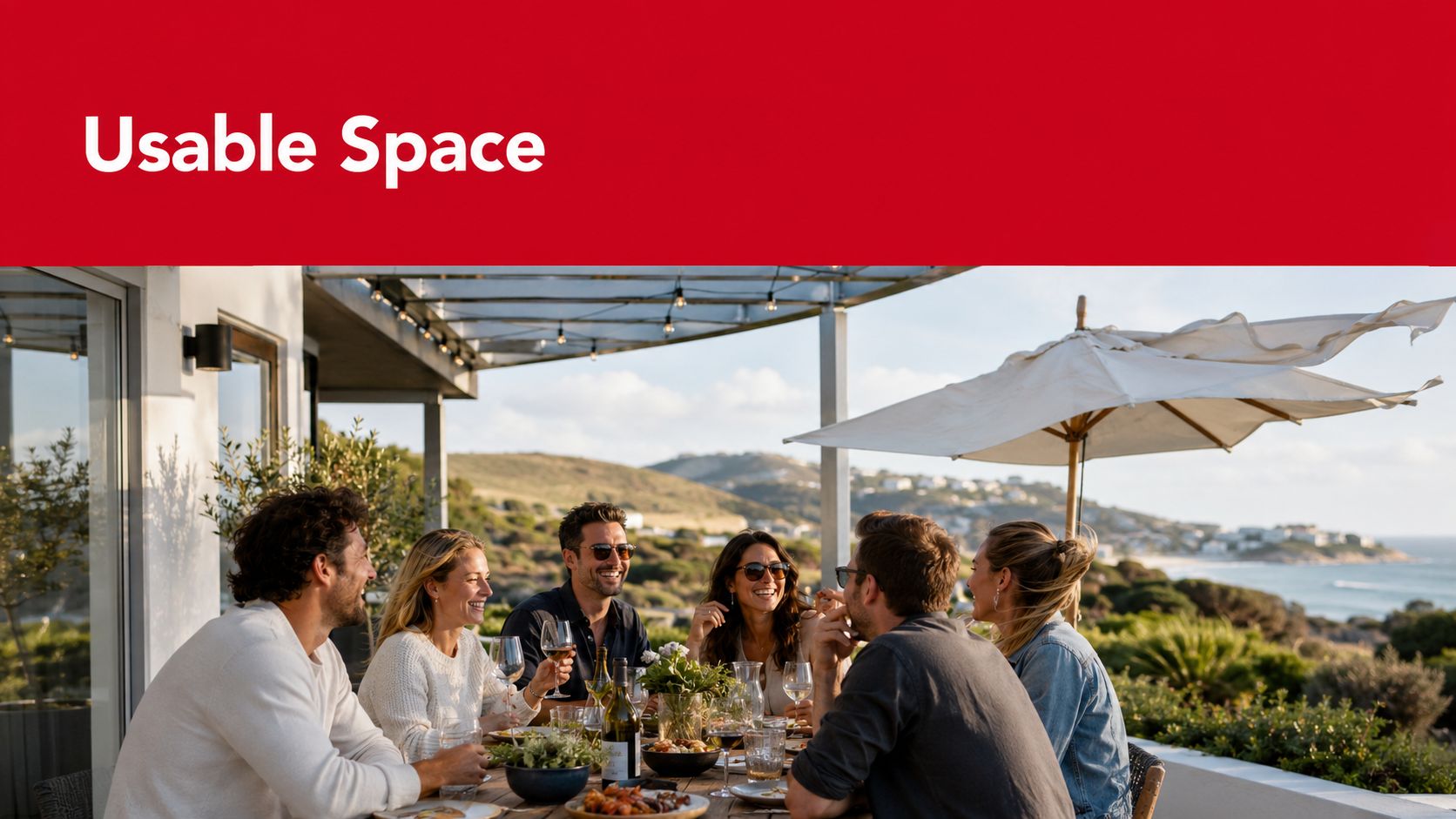
An open pergola can look finished while still being difficult to use. Rain can blow in from the side, low sun can make a table uncomfortable, and a gust across an exposed block can turn loose fabric into a noisy distraction. Blinds add a controllable edge to the space without making every outdoor area feel permanently enclosed.
That distinction matters in suburbs such as Wamberal, Bateau Bay and Gosford, where the right result depends on orientation and exposure rather than appearance alone. A blind on the western side may be selected mainly for glare and afternoon heat. A blind beside a coastal dining area may need better guidance and fastening because wind and salt air place more demand on the hardware.
Start with how the space will be used
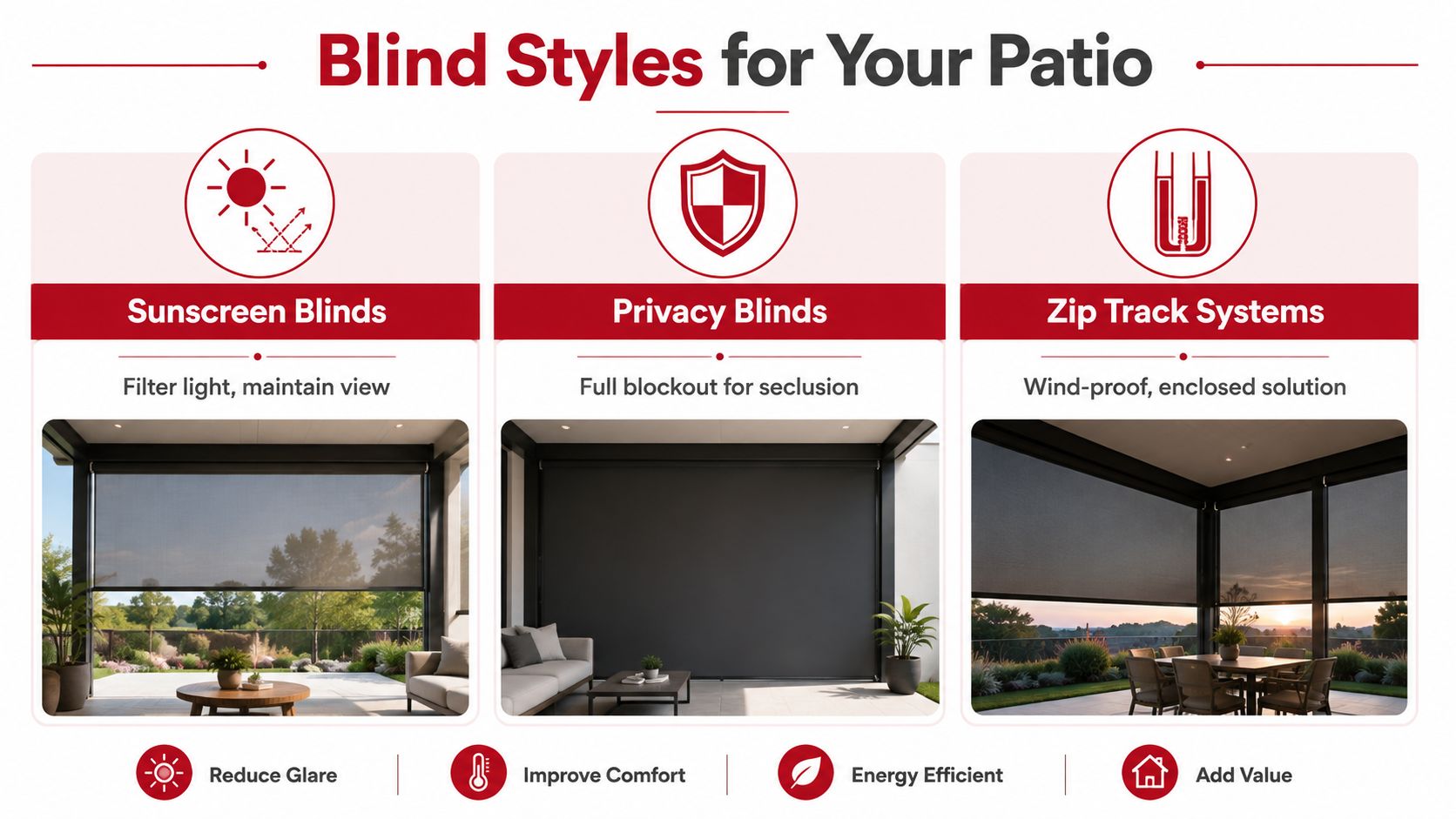
Sunscreen fabric can preserve a connection with the garden or ocean while reducing glare. Privacy fabric suits a verandah that faces a neighbouring home or a busy footpath. A guided system makes more sense where the homeowner wants a closer wind and weather barrier, rather than a blind that just rolls down and hangs freely.
Outdoor blinds can also support thermal comfort. Sunscreen outdoor blinds are described as reducing up to 85% of the sun’s heat and up to 99% of damaging UV rays, according to Australian sunscreen blind information. The actual result still depends on fabric selection, orientation, ventilation and how much of the opening is covered.
Homeowners considering the broader layout can use patio design ai as an early visual planning resource. It can help clarify furniture placement and sightlines, but it can’t replace a site measure, structural check or approval review.
A blind works best when it belongs to a wider design. Roof pitch, post positions and drainage all influence the mounting line, so the choice of patio roof types should be considered before the blind order is finalised.
Choosing the Right Blind Style for Your Space
The right blind style is determined by the job it needs to perform. A north-facing entertaining area in Terrigal may need solar control and a clear outlook. A lakeside verandah in Toukley may need privacy at certain times of day. A wind-exposed pergola in Bateau Bay may need a guided system that holds the blind more securely.
Match the fabric to the outcome
A sunscreen blind filters light rather than creating a dark internal room. It can suit a patio where the household still wants to see the garden, pool or coastline. The fabric’s openness and colour affect glare, privacy and the amount of outward visibility, so a sample viewed outdoors is more useful than a small indoor swatch.
A privacy-oriented fabric gives up some view in favour of seclusion and stronger visual separation. It works well beside a boundary, near a neighbour’s window or around an outdoor dining setting that needs a calmer backdrop. The trade-off is that a denser fabric can make the area feel more enclosed, particularly when several sides are covered.
Practical rule: Choose the blind for the uncomfortable part of the day, not just for the moment the patio looks its best.
Know when guidance matters
Roll-up systems can be straightforward for sheltered openings, but free-hanging fabric has less resistance to movement than a channel-guided blind. Zip-track or similar guided systems hold the edges in position and can provide a more enclosed solution where wind exposure is a concern. They still need correct fixing, suitable tension and sensible use during severe weather.
Motorisation earns its place on larger openings, frequently used blinds or areas where several blinds need to operate together. It also avoids reaching across furniture or repeatedly using a manual control. Manual operation can remain practical for a smaller opening, especially where the blind is only adjusted occasionally.
The Ambient range suits many local projects because it can be considered as part of a custom outdoor living design rather than treated as a loose add-on. Examples of completed applications can be viewed in the Ambient sunblinds and outdoor privacy projects, with the final selection still dependent on the opening, structure and exposure.
Site Assessment and Measuring for a Clean Fit
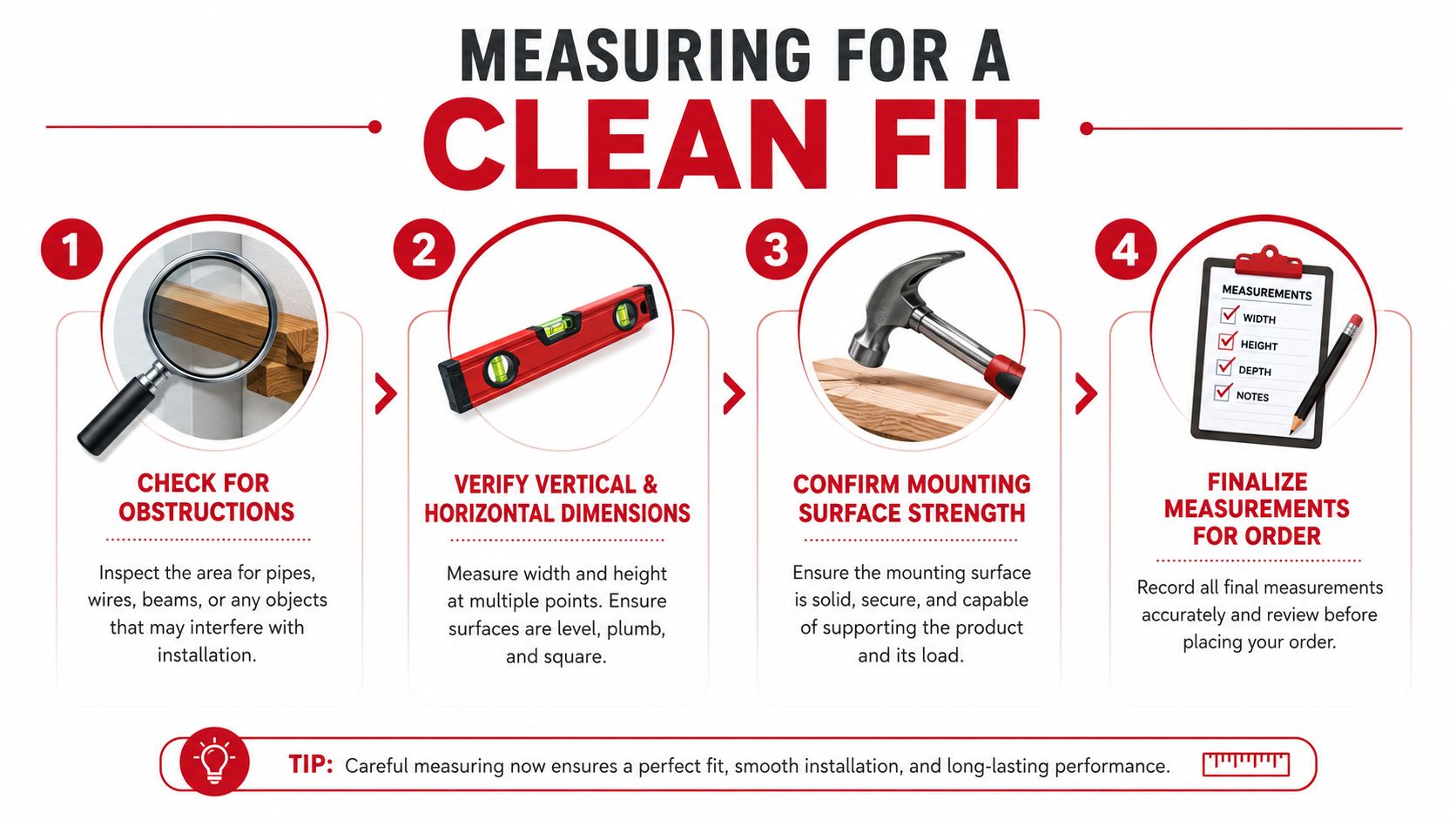
A clean fit starts before anyone picks up a drill. Check downpipes, lights, gutters, beams, posts, doors, handles and trim that could interfere with the cassette, brackets, side guides or bottom rail. On coastal homes, also record the opening’s exposure to salt air and prevailing wind. That information affects the fixing method, hardware selection and whether a lighter blind is suitable for the site.
Measure the vertical and horizontal dimensions at several points, then confirm the mounting position rather than relying on the visible gap. A wall can taper, a beam can bow and a projecting trim can reduce clearance. These small differences may leave the blind binding, rubbing or failing to close evenly.
Level comes before tightening
Check the top of the opening for level before fixing the brackets. Once the blind is positioned, use a spirit level to confirm that the cassette or headbox is straight. A generic external blind installation guide sets out the practical sequence: level the assembly before final tightening, check its travel, then set motor limits after power-up.
An opening that is out of square can cause tracking friction, an uneven fabric roll and faster wear. If fabric repeatedly creeps to one side, alignment may be the problem rather than the blind itself. Record each measurement, identify the mounting surface and note any packing or levelling required before drilling.
Check the structure, not just the surface
An aluminium patio beam, timber pergola and masonry wall each require a different fixing approach. The visible finish may be cladding, render or decorative timber, but the fastener must reach a suitable structural substrate. In exposed Central Coast locations, salt air makes corrosion-resistant brackets and fasteners a practical requirement, particularly around Terrigal and Wamberal.
The quote should identify the fixing substrate and explain how the installer will handle an uneven beam, sloping paving or limited anchoring depth. It should also show enough clearance for doors, drainage and future servicing.
Homeowners comparing layouts can use the patio size calculator during early planning, then arrange an on-site measure for the final order and confirm that the proposed blind suits the structure, wind exposure and shading goals.
Council Approval and BASIX Shading Rules on the Central Coast
Outdoor blinds can fall within different approval pathways in New South Wales. A proposal may qualify as exempt development when it meets the relevant standards. If it doesn’t meet those standards, a Development Application may be required, while some proposals may be eligible for a Complying Development Certificate.
The NSW planning guidance for awnings, blinds and canopies states that these works can be exempt development when the State Environmental Planning Policy requirements are met. The relevant checks can include location, size, heritage status and other site conditions. Central Coast Council and Lake Macquarie City Council should be consulted for current property-specific requirements.
Enclosure changes the planning question
A blind across one opening isn’t always treated the same way as blinds around an entire alfresco area. Once a perimeter enclosure functions like a new room, approval, building and insurance questions can become more significant, especially for attached dwellings, strata properties, heritage sites or homes affected by bushfire overlays.
The NSW Planning Portal’s external louvres and blinds guidance recognises motorised blinds, fixed blades and sliding screens with fixed or adjustable blades as external louvre or vertical blind devices. The classification also considers whether the device can retract to allow winter sun.
That matters because BASIX thermal-performance rules are connected with window shading design. The guidance defines an external louvre or vertical blind as a device that can pull down or across to completely cover a window. Devices that don’t completely cover the opening cannot be nominated as DIY in the relevant guidance, so full-coverage external blind systems may be the appropriate compliance category for some installations.
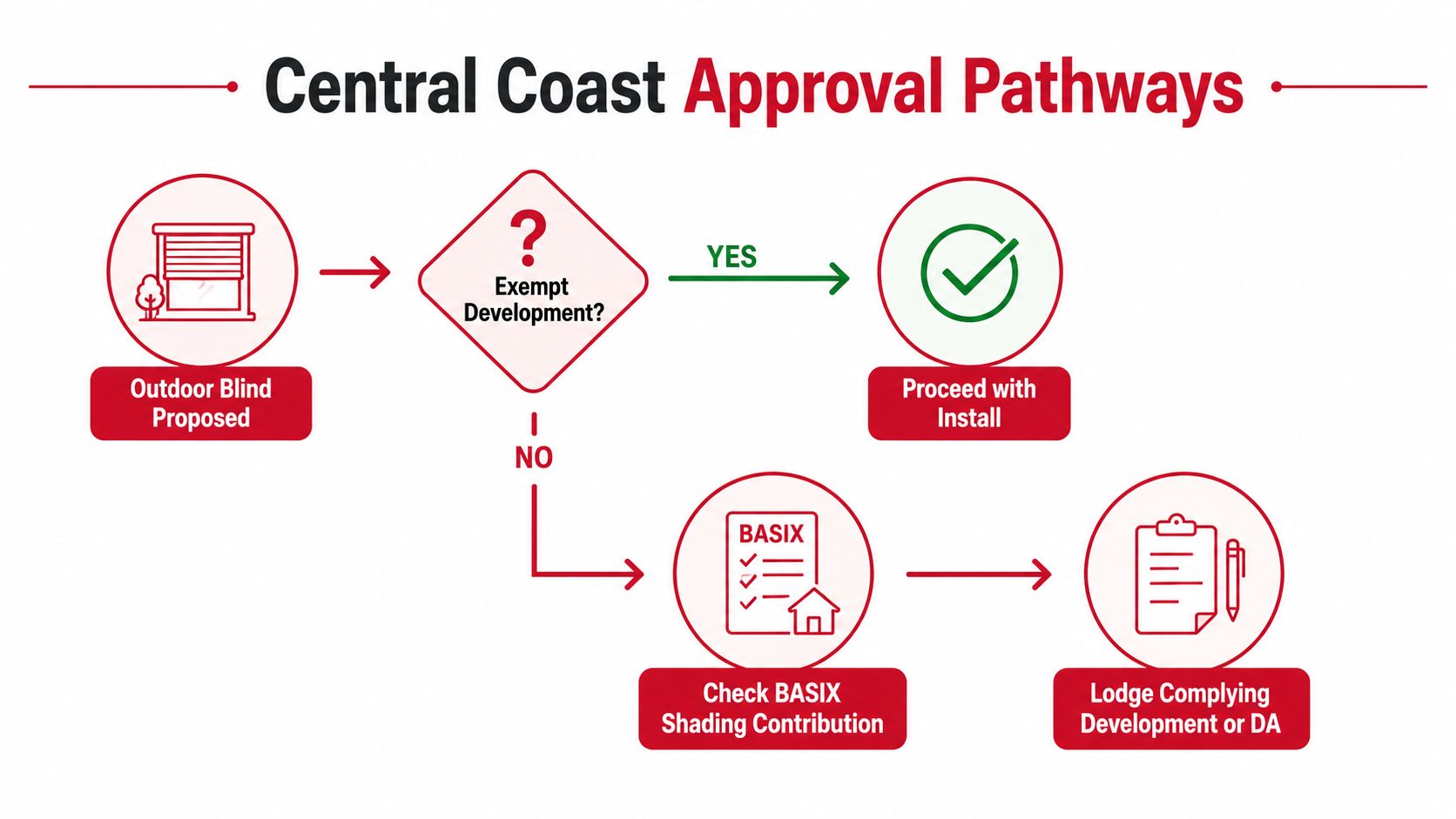
Confirm the pathway before ordering
A compliant design protects more than the installation itself. It can support insurance records, reduce resale uncertainty and prevent a finished enclosure from needing alteration later. The NSW Planning Portal and the relevant council remain the right sources for current rules, particularly where a modern pergola design is being combined with multiple blind openings.
Installation Steps From Pre-Drill to Weatherproofing
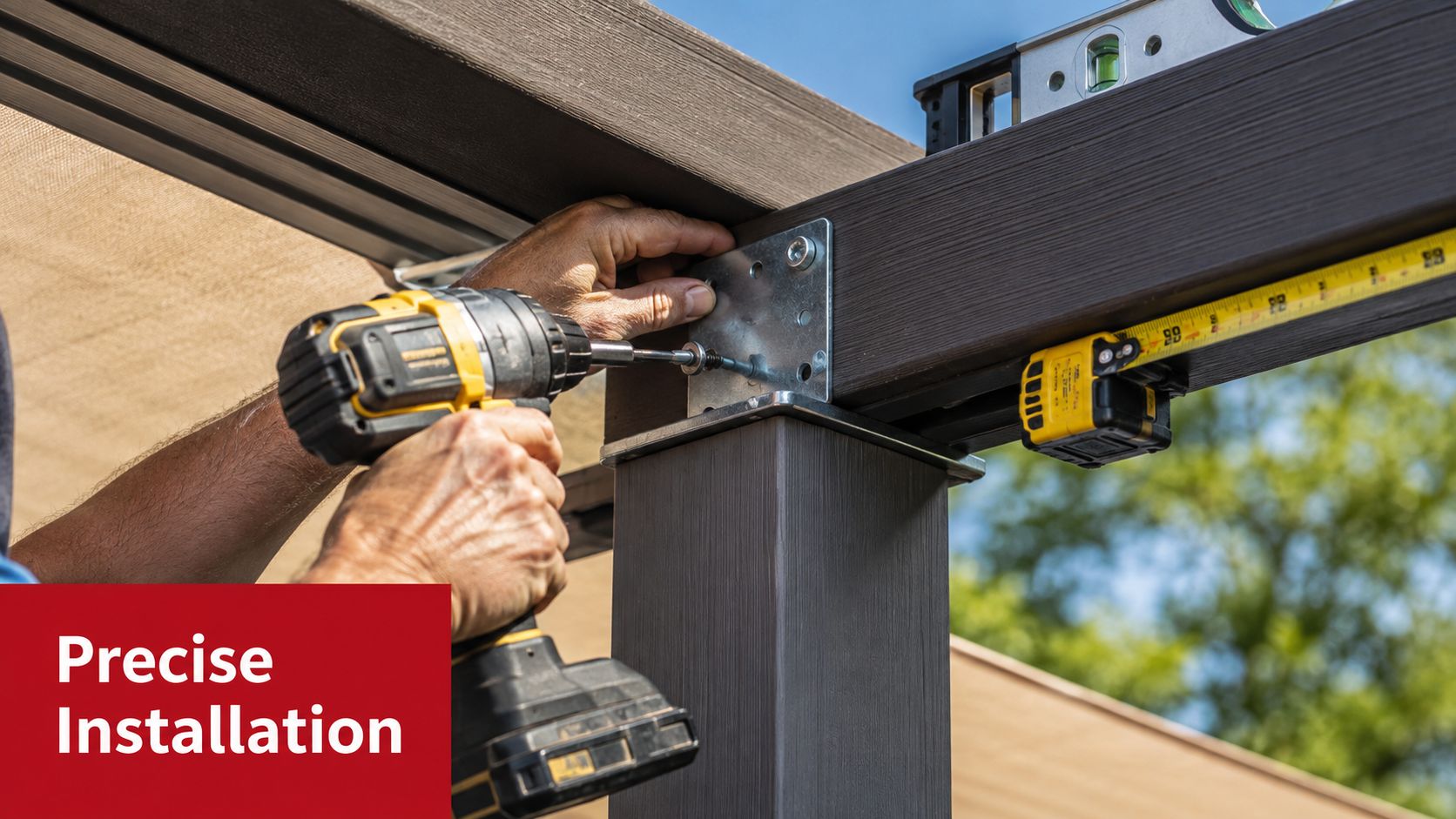
On a Central Coast patio, drilling starts only after the opening and structure have been checked. Confirm clearances, locate sound timber, masonry or steel, and mark each bracket position. Pre-drilling helps protect finished surfaces and keeps fixings aligned with the material behind them.
Fix the brackets to the wall, ceiling, beam or post required by the mounting method. Hang the blind, level it, and tighten the fixings only after checking its movement. For a guided system, side channels or tracks must remain straight so the bottom rail travels without binding.
Treat wind as a design condition
Wind exposure determines more than whether the blind feels firm. It affects bracket spacing, substrate choice, guide details and the need for tie-downs. Manufacturer fitting instructions report that track-guided blinds installed with a recommended windy-area fixing method remained functional after simulated winds over 160 km/h for a standard 2.5 m by 2.5 m blind. The same document refers to N1 and N2 wind-rating areas, with gusts of up to 28 m/s and 33 m/s. These figures apply to the stated setup, not every blind, opening or property. See the Australian outdoor blind fitting instructions before selecting fixings.
An exposed home in Bateau Bay, a sloping block near the water or a property in Toukley may need windy-area fixings and tie-downs. The installer should match those details to the product instructions and the structure, rather than rely on a generic bracket arrangement. Tie-downs limit movement in mild to moderate wind, but the blind should still be secured or retracted when conditions exceed its operating guidance.
Finish with testing and sealing
Seal every penetration for the wall material and coastal exposure. This reduces the chance of rain tracking behind brackets and helps protect the fixing zone.
Powered blinds need their travel and motor limits tested after power-up. Run the blind through its full range and check for rubbing, early stopping, uneven rolling or track resistance. Manual systems need the same movement check.
Leveling errors often become obvious only after weather and repeated use. At handover, demonstrate normal operation, explain the wind procedure, and provide care and warranty information. Record the fixing details and any limits that affect future use.
Costs, Timelines and DIY Versus Professional Installation
The short answer is that outdoor blinds installation pricing depends on the blind type, opening size, fabric, control method, mounting surface and site access. Coastal corrosion protection, difficult drilling, sloping blocks and additional wind fixing can all change the scope. A guide range helps with early budgeting, but it isn’t a quote from Outdoor Leisure Living.
| Blind Type | Typical Size | Guide Range |
|---|---|---|
| Sunscreen blind | Small single opening | Market guide range varies by site and fabric |
| Privacy blind | Medium patio opening | Market guide range varies by site and fabric |
| Guided or zip-track system | Large or exposed opening | Market guide range varies by site and fixing method |
| Motorised outdoor blind | Multiple or frequently used openings | Market guide range varies by controls and electrical work |
The table is intentionally qualitative because a reliable fixed figure can't be produced without measuring the opening and checking the structure. A free on-site design consultation replaces the guide range with a fixed-fee quote, with the scope defined so there are no surprises from avoidable omissions. Interest-free finance may also be available, subject to current promotions, and homeowners can review general finance considerations through Moneysmart's borrowing guidance.
DIY kits versus professional fitting
A kit can suit a simple, sheltered opening where the homeowner understands the substrate, has suitable tools and can follow the manufacturer's instructions precisely. It becomes less attractive when the opening is out of square, the wall is masonry, the structure is coastal-grade or the blind needs guided wind performance.
Professional supply and installation also creates a clearer record of measurements, fixing decisions, motor settings and warranty handover. The installer can identify a problem before drilling rather than discovering it after fabric or brackets have been damaged. Homeowners planning the wider structure can compare the Central Coast patio cost guide before booking an on-site consultation, and a broader backyard planning resource such as the DreamYard landscape design guide can help coordinate planting, paths and furniture around the finished space.
Maintenance, Troubleshooting and Warranty Handover
Coastal blinds need simple, regular care. Salt residue can collect in tracks, brackets and moving joints, particularly near the ocean or a lakeside property. A gentle clean with suitable water and mild cleaning products, followed by thorough drying, helps prevent residue from interfering with movement.
After a significant storm, the homeowner should inspect alignment, track tension and visible fixings before using the blind again. Moving parts should only be lubricated with products approved for the system, because the wrong lubricant can attract grit or affect fabric and seals.
Separate simple checks from technical repairs
A blind that binds in the track may have debris, a displaced guide or an alignment issue. Cleaning and checking for an obvious obstruction is reasonable, but forcing the blind can damage the fabric or mechanism. A motor that stops mid-travel may need a reset or limit check, while repeated stopping requires a technician rather than repeated cycling.
Fabric that creeps to one side usually points to levelling, tracking or roll alignment. It isn't a problem to solve by pulling the fabric sideways by hand. If the issue returns after a basic visual check, the installer should assess the system.
Keep the handover record
The outdoor blinds warranty is 10 years, while eligible Stratco patios, pergolas and carports carry a 25-year warranty. Those warranties apply to different product categories, so the homeowner should keep the product details, installation record, care instructions and warranty documentation together.
A proper handover should explain operation in wind, cleaning, motor controls and the point at which support is needed. Outdoor Leisure Living can design, supply and install outdoor blinds as part of its local outdoor living service, with site-specific advice for homes across the Central Coast and Lake Macquarie.
Frequently asked questions
Do outdoor blinds always need council approval?
No. Some awnings, blinds and canopies may qualify as exempt development when every applicable standard is met. Check the NSW Planning Portal and the relevant council before ordering.
Can blinds enclose an alfresco area?
They can, but a full perimeter enclosure may be treated differently from a single blind and could raise additional planning, building or insurance questions.
Are sunscreen blinds suitable for a north-facing patio?
They can be, particularly where the priority is glare, heat and UV control while retaining an outlook. Fabric and coverage should be selected for the actual orientation.
What causes a blind to roll unevenly?
An out-of-level cassette, uneven opening, misaligned guides or incorrect tension can all contribute. The system shouldn't be forced.
Are outdoor blinds suitable for coastal homes?
They can be, provided the product, fixings and maintenance routine suit salt air, humidity and wind exposure.
Is professional installation worth considering for a DIY project?
It is especially useful where the opening is large, exposed, sloping, masonry-mounted or connected with approval and BASIX considerations.
Outdoor Leisure Living is the Central Coast's authorised Stratco and Stratco Outback dealer: family owned, over a decade in business with more than 35 years of industry experience, and 75+ five-star reviews across the Central Coast and Lake Macquarie.
Outdoor Leisure Living can assess the opening, explain the suitable blind styles, check the mounting conditions and coordinate a fixed-fee outdoor blinds installation for the property. Visit Outdoor Leisure Living to arrange a free on-site design consultation and discuss the right approach for shade, privacy and coastal durability. Book your free on-site design consultation. Call 0494 571 131.