




Imagine stepping out with a cup of tea onto a timber deck that was meant to be the best seat in the house, only to find dull grey boards, blackened corners, and fixings that have started to lift. On the Central Coast and around Lake Macquarie, that sort of change doesn’t happen slowly enough for complacency, because salt air, humidity, wind, UV, and rain all work on timber at once. Good timber deck maintenance isn’t about making a deck look freshly built every weekend, it’s about stopping small moisture problems from turning into expensive structural ones.
The short answer is simple, keep the deck clean, keep water moving, and inspect the hidden areas as carefully as the top surface. A deck that looks tidy can still be trapping moisture underneath, and that’s where rot usually starts. The jobs that matter most are the ones that prevent water sitting in board gaps, under planter boxes, along the house edge, and beneath the frame.
Table of Contents
- Why Coastal Decks Need Different Care
- The Annual Inspection Checklist
- Cleaning Methods That Actually Work
- The Hidden Moisture Problem Under Your Deck
- Repairs, Sanding, and Sealing for Coastal Conditions
- Your Realistic Annual Maintenance Schedule
Why Coastal Decks Need Different Care
A deck in Terrigal or Wamberal copes with a different reality to a deck inland. Boards don’t just age from foot traffic, they fade, hold salt residue, and stay damp longer after rain or morning dew. That’s why the same maintenance rhythm that works in a drier suburb often falls short near the ocean or the lake.

The contrast shows up quickly. A well-kept deck still has clean board gaps, tight fixings, and coating that sheds water. A neglected one starts to grow slippery film in the corners, then the surface fibres lift, and fasteners begin working loose as the timber moves.
Practical rule: if water sits anywhere on a deck for too long, timber starts losing the fight, especially around shaded or poorly ventilated edges.
That’s why maintenance has to reflect local conditions rather than a generic checklist. Industry guidance commonly places pressure-treated wood decks at about 10 to 15 years of life, while composite alternatives are often estimated at 25 to 30 plus years. In a 2026 consumer survey of wood-deck owners, 78% said they regretted choosing wood, 56% cited weathering, 45% cited staining or painting, and 44% cited fading or discolouration as major pain points, while 43% spent more than 10 hours per year maintaining their deck and 76% spent at least $100 annually on upkeep, according to the cited industry press release. Those numbers matter even more on exposed coastal blocks in places like Bateau Bay, Gosford, and Toukley, where UV and moisture speed up the maintenance cycle.
Material choice sets the baseline for how much work a deck will ever need, because timber, composite and steel-framed decks all behave differently once salt air and constant wet-dry cycling get involved.
Compare timber and composite decking for Central Coast homes
The Annual Inspection Checklist
A proper inspection starts before the broom comes out. The aim is to find movement, softness, corrosion, and drainage problems before they spread, because a deck that has started to fail usually gives off clues long before a board breaks.

Check the structure first
Walk the deck and listen as much as you look. A hollow sound, bounce, or visible flex can mean fixings have loosened or the substructure is moving. Consumer guidance notes that decks 10 years old or more should be inspected at least every five years, and injury figures cited from the U.S. Consumer Product Safety Commission point to about 8,700 injuries and 2 fatalities linked to deck, porch, and balcony collapses and flooring failures between 2020 and 2024 (Consumer Reports deck maintenance and safety guide).
Look closely at posts, bearers, joists, and balustrades. Any wobble in the handrail or movement at the ledger line deserves attention, because those are the areas that carry load rather than hold up appearance.
Then test the surface
Use the inspection to identify splintering, cupping, lifted grain, and any board that feels soft underfoot. Probe suspicious spots near stairs, around downpipes, and in shaded corners where moisture tends to linger. If sealant is still working, water should bead rather than soak straight in.
A deck can look fine from the back door and still be failing where the boards meet the frame.
The practical value of this habit is simple. It gives homeowners a priority list, so the most serious defects get fixed before a cosmetic clean or stain becomes the main focus. For decks attached to a house wall, compliance, structure, and drainage all matter together, which is why it makes sense to check roofing and shade changes at the same time as the deck itself. A useful starting point is a look at patio roof types for coastal homes, because overhead cover changes how much water and UV the deck receives. Insulated Cooldek and Prodek roofing does the same job while keeping the space underneath noticeably cooler.
Cleaning Methods That Actually Work
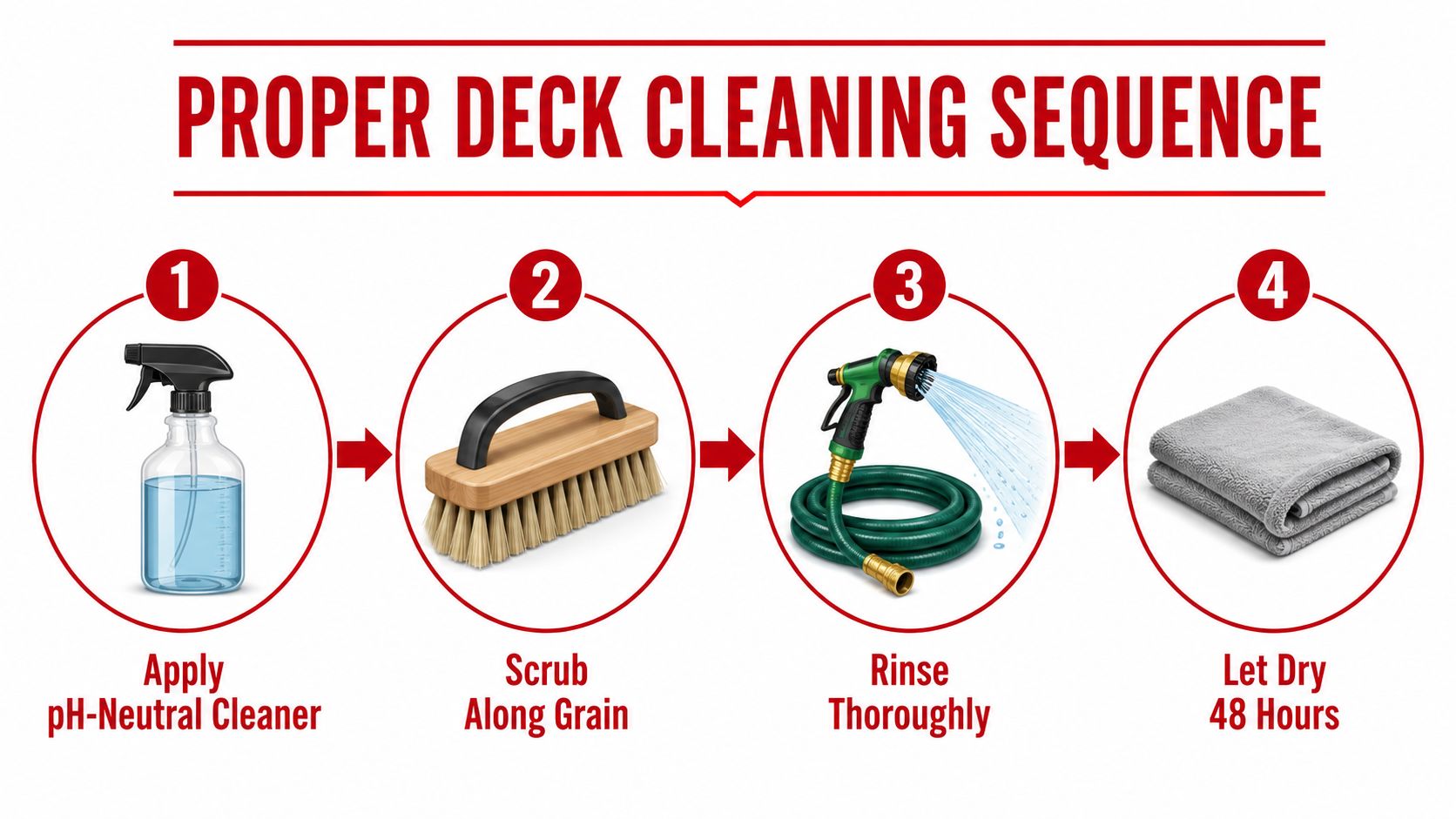
A pressure washer looks efficient, but it’s often the wrong first move. High pressure can scar timber fibres, push moisture deeper into the wood, and leave the surface looking rougher after the job than before it. The better approach is slower, lighter, and much more controlled.
Start with dry maintenance
A weekly dry-brush or sweep removes the leaves, grit, and salt film that hold moisture against the timber. The Timber Decking and Cladding Association notes that regular brushing and annual cleaning help remove algae and dead leaves that can make timber slippery in wet conditions, and Australian timber guidance also treats weekly sweeping and annual deep cleaning as the base routine (TDCA maintenance guidance). That small weekly habit does more than most homeowners expect.
If the deck sits under a pergola or louvre roof, or close to a retaining wall, make sure the corners get the same attention as the centre. Debris always settles where air movement is weakest.
Clean in sections, not all at once
For the annual wash, use a mild detergent or a proprietary deck cleaner, work in sections, and scrub with the grain using a stiff brush. Hardwood guidance from JSC Timber recommends annual cleaning with water and mild detergent, a 1:10 bleach solution, or a proprietary cleaner, while also warning that high-pressure water can permanently damage timber decking (JSC hardwoods decking guide). That warning matters on older decks where the fibres have already started to lift.
Use bleach only where a product specifically calls for it, and avoid soaking the deck. A quick rinse is enough once the grime has lifted.
Deal with weathering before it turns permanent
Greying on exposed boards is usually UV and weather exposure rather than a failure by itself, but the grey layer often hides early mould, surface checking, or patchy wear. If the deck has stubborn staining, a careful spot clean beats aggressive scrubbing every time. The goal is to restore the surface without stripping it raw.
Reducing the exposure helps as much as recoating does. On a west-facing deck, Stratco Ambient outdoor blinds cut the direct afternoon sun and keep driving rain off the boards, which slows both the fading and the wet-dry cycling that opens up surface checks.
Allow the deck to dry fully after washing before any coating work. Many deck-care guides recommend a 48-hour drying period after cleaning before stain or sealer is applied, because trapped moisture blocks proper absorption and leaves coatings patchy (deck maintenance care checklist).
The Hidden Moisture Problem Under Your Deck
Most failed decks don’t start with the top boards. They start where nobody looks, under the frame, against the wall, around the planter box, or in the corner where leaves keep settling after every windy day. Surface cleaning helps, but it won’t fix a damp substructure.
If a deck is built near a wall or embedded into landscaping, hidden moisture needs more attention than the visible finish. Several guides point to the need for a gap between decking and cladding, clearing trapped debris, and avoiding material that sits and holds water, and that points straight to substructure hygiene as a major maintenance task. Poor airflow under the deck slows drying, and slow drying means rot has more time to start.
Check the underside and the edges
The safest way to inspect underneath is from the side or from open access points, not by crawling into unsafe spaces. Look for leaf buildup, blocked gaps, damp joist ends, rust stains on fixings, and any dark staining where timber meets concrete or masonry. A sloping yard or lakeside block can also move water towards the frame if drainage isn’t planned properly.
Skirting matters here too. Solid boarding around the base looks neat but seals the space in, whereas slatted aluminium privacy screens keep the underside tidy while still letting air move through and dry it out.
Bottom line: if the underside stays damp, the deck ages from the inside out.
This is also the point where leak detection becomes relevant, because water marks near the house wall are not always caused by the deck itself. A plumbing or stormwater fault can mimic a timber problem, so a specialist inspection can save a homeowner from replacing boards that are only showing the symptom. If a stain or damp patch keeps returning in the same spot after the deck has been cleaned and dried out, it is worth having a plumber check for a leak before any boards come up.
Don’t ignore drainage gaps
Keep the spaces between boards clear, and don’t let pots, mats, or stored items sit in place long-term. General timber decking guidance also recommends a positive drainage fall rather than a perfectly level installation, and it notes that nails may need to be driven flush and screws tightened if shrinkage or movement starts to loosen them (Wood Components Ireland maintenance guide). Those are small details, but they decide whether water escapes or lingers.
See an example of a flyover Cooldek roof with deck stairs
Repairs, Sanding, and Sealing for Coastal Conditions
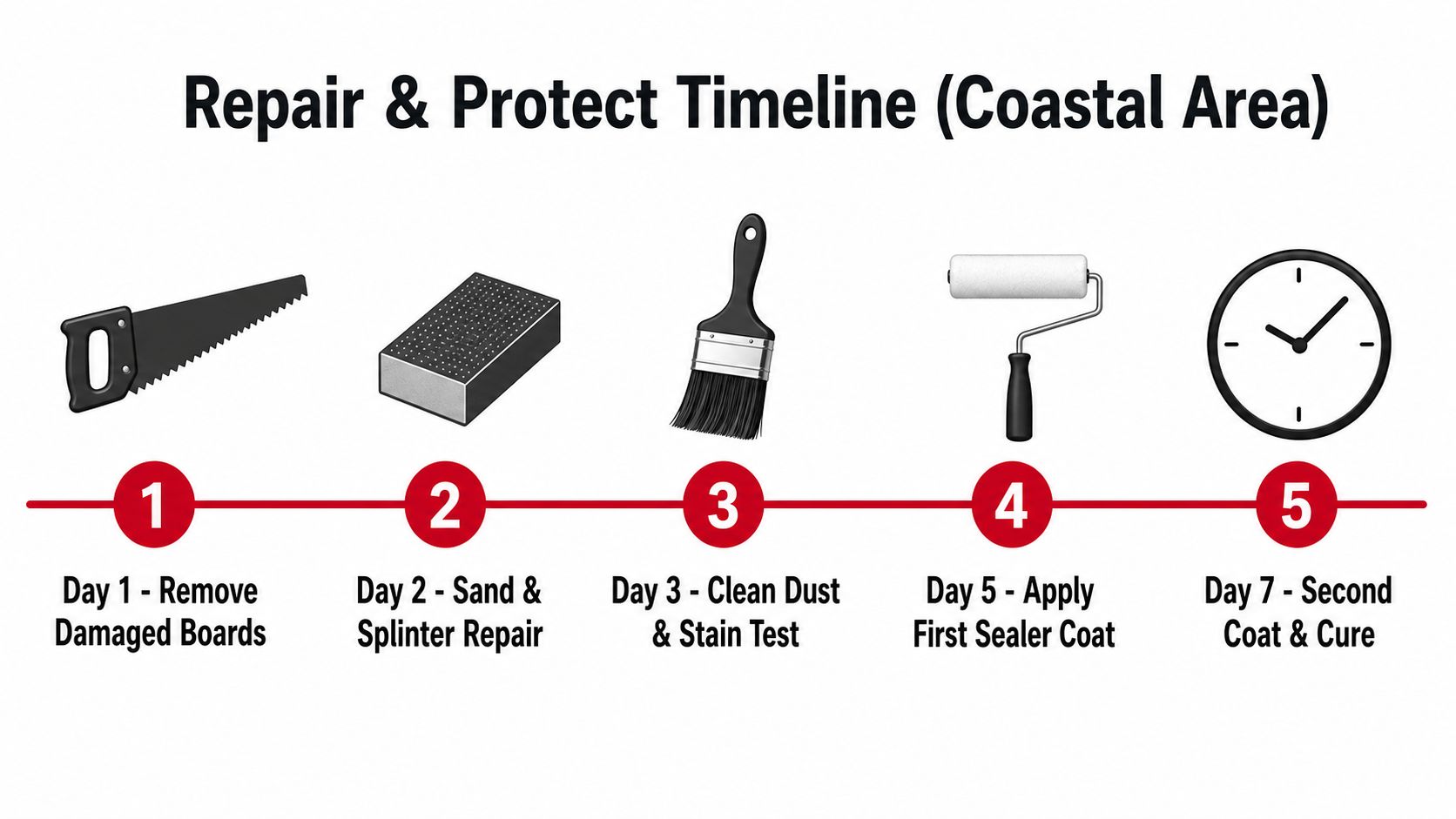
Once the deck is clean and dry, the next question is what needs fixing. Loose boards, popped nails, and minor surface damage can often be handled before they become major structural work, but the repairs have to be done in the right order.
Repair before you coat
A damaged board should be dealt with before stain or oil goes on. The reason is simple, coatings don’t fix movement, and they won’t hold properly over loose timber or failing fasteners. If a few screws have backed out, tighten them. If nails have popped, drive them flush or replace them where appropriate.
For minor roughness, sanding should stay targeted rather than broad-brush. Sand the lifted fibres, splintery spots, or old finish that’s flaking, but don’t grind the whole deck unless it needs it. Over-sanding can make the surface more open to water and faster to weather again.
Match the coating to the environment
Coastal decks need protection that suits UV exposure and repeated wetting. Oiling keeps a more natural feel, while sealing can provide a longer-lasting surface barrier depending on the product and the timber type. A common mistake is applying too much, or applying the wrong product over an incompatible previous finish.
The right choice still depends on the deck’s species, exposure, and prior treatment, so check the manufacturer’s guidance for that specific timber before buying a tin. A coating that works on one deck can behave poorly on another if the timber is dense, weathered, or already over-oiled.
Know when to stop DIY
If rot is soft enough to crumble, if multiple boards are failing, or if movement is showing in the frame, it’s time for a professional assessment rather than more patching. That’s especially true on decks near the coast, where corrosion and moisture travel together. A team that handles deck design, repair and installation on the Central Coast should explain the scope clearly, provide a fixed-fee quote, and account for the condition of the deck before promising a quick refinish.
For decks that need more than maintenance, the same logic applies to roofed outdoor areas. A covered structure changes how much sun and rain the timber sees, and the detailing matters just as much as the finish. Pairing a deck with a custom Stratco patio is the most reliable way to cut how often the boards need recoating. An example of that kind of integration can be seen in Cooldek roof and merbau deck projects.
Your Realistic Annual Maintenance Schedule
A deck stays healthy when the work is spread through the year instead of crammed into one long clean-up. The goal isn’t perfection, it’s a routine that fits real weekends, real weather, and the way Central Coast homes get used for barbecues, family lunches, and wet-weather traffic.
Keep the schedule light but consistent
Spring is the time for a full clean, a fresh inspection, and any resealing or oiling that the deck needs before the entertaining season starts. Summer maintenance can be lighter, a weekly sweep, a quick fastener check, and immediate attention to spills or leaf litter. Autumn is the right moment to clear leaves before they settle into damp corners, while winter is about checking drainage paths and moisture traps after storms.
That rhythm suits busy households in Erina, Gosford, Wyong, and the lakefront suburbs because it avoids the common trap of letting the deck slide until it needs major repair. It also helps preserve the long-term value of professionally installed decks, where routine care protects the finish and keeps small problems from spreading into the structure.
Keep records that actually help
A simple note on the phone is enough. Record when the deck was last washed, whether fasteners were tightened, and where any soft spots or finish failures were found. That history matters later, because timber moves seasonally, and repeated issues in the same corner usually tell the underlying story.
Useful habit: if the same area needs attention twice, there’s usually a drainage or airflow problem behind it.
For homeowners who want a broader maintenance plan around a covered outdoor area, the same seasonal thinking applies to roofing and shade structures. The local climate doesn’t change because the deck is under cover, it just changes how quickly moisture dries out and how often the finish needs attention. A practical reference point is maintenance tips for Stratco patio and carport conditions in Central Coast weather.
Use the warranty period wisely
The decks we build for Central Coast and Lake Macquarie homes carry a 10-year warranty, so keeping cleaning, inspection, and coating records is more than tidy administration. It shows when the deck was maintained, what was found, and whether problems developed through wear or neglect. That kind of record makes decisions clearer if a repair ever needs to be assessed against warranty documentation.
Frequently Asked Questions
What should be checked most often on a coastal timber deck?
Board gaps, fasteners, drainage paths, and any signs of softness or rot near edges, posts, or the house wall.
Is pressure washing safe for timber decking?
Only with great care, and many timber guides warn against high pressure because it can damage the fibres and force water deeper into the wood.
How often should sealing or oiling happen?
Many Australian timber-care guides point to oiling or staining every 12 to 18 months depending on exposure, but the deck’s condition should decide timing more than the calendar.
Why does the underside matter so much?
Because trapped moisture under the frame is one of the fastest ways for timber to soften, rot, and loosen fixings.
Can a deck look fine and still be unsafe?
Yes. Surface appearance doesn’t reveal hidden movement, corroded fixings, or damp substructure damage.
When is it time to call a professional?
When multiple boards are failing, when rot is soft and spreading, or when movement in posts, rails, or the frame points to structural work rather than a simple repair.
About Outdoor Leisure Living
Outdoor Leisure Living is the Central Coast’s authorised Stratco and Stratco Outback dealer: family owned, over a decade in business with more than 35 years of industry experience, and 75+ five-star reviews across the Central Coast and Lake Macquarie.
Outdoor Leisure Living designs and installs outdoor living solutions that suit coastal conditions, from timber decks and integrated roofing through to custom patios and pergolas. If your deck needs a better maintenance plan, a repair assessment, or a new covered entertaining area that makes upkeep easier, arrange a free on-site design consultation.
Book your free on-site design consultation. Call 0494 571 131.