



Imagine pulling up a chair under your own deck this weekend, barbecue going, salt air drifting in from the coast, and the afternoon shade sitting just right over the seating area. On the Central Coast, that feeling is what most homeowners are really buying. The timber vs composite decking decision only looks simple until you put it into coastal NSW conditions, where UV, moisture, wind, and maintenance habits change the whole equation.
The short answer is blunt. Timber decking boards usually sit around $60 to $180 per m² for materials only, while composite decking boards usually sit around $100 to $190 per m² for materials only, so composite often costs more upfront. But once maintenance is folded in, the picture changes. That same Australian comparison puts timber maintenance at $30 to $80 per m² per year, and for a typical 30 m² deck, the 20-year cost lands around $11,400 to $27,400 for timber versus $6,900 to $12,900 for composite when maintenance is included.
That’s the choice on the Coast. Not “which board looks nicer in a brochure”, but which deck suits your block, your budget, and your tolerance for upkeep. A free on-site consultation is where the actual fixed-fee figure gets worked out for your home, because the right number depends on the site, the subframe, and the finish you want.
Table of Contents
- The Weekend You Want and the Deck That Gets You There
- The Four Criteria That Matter on the Central Coast
- Timber Decking on the Central Coast
- Composite Decking on the Central Coast
- Maintenance Schedules and Lifecycle Costs Over Twenty Years
- Matching the Material to Your Central Coast Block and Lifestyle
- Approvals, Quotes and What to Ask Your Installer
- Common Questions and Next Steps
The Weekend You Want and the Deck That Gets You There
A north-facing deck in Wamberal can feel perfect at breakfast and brutal by lunchtime if the material and the build are wrong. Salt sits in the air, the boards take full UV, and poor detailing gets punished fast. On the Central Coast, the timber vs composite decking choice is never just about looks.
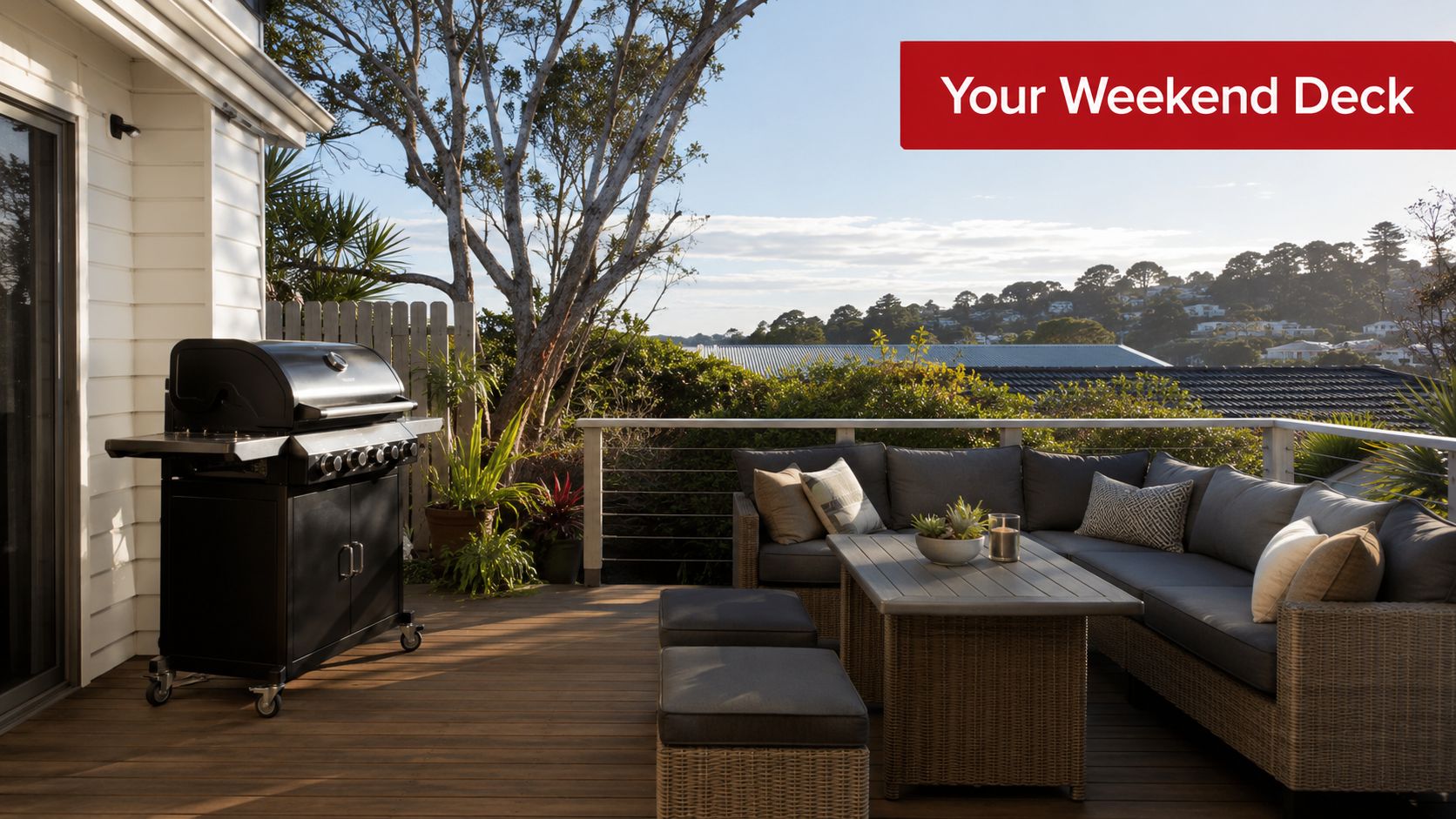
Practical rule: if you want a deck that keeps its good looks with less work, composite is worth a serious look. If you want natural feel, easy refinishing, and a lower entry price, timber still has a place.
The upfront numbers are clear. Timber materials usually come in lower, composite usually starts higher, and that gap can be obvious before labour is even counted. Over the long run, though, the picture changes once you factor in cleaning, oiling, recoating, and replacement cycles across the life of the deck. Brite Decking discusses that trade-off in plain terms. Brite Decking
That is why a square-metre price on its own can mislead. A deck in Terrigal or Erina does not live in a display yard. It copes with wind, moisture, afternoon sun, and coastal grime, so the right choice has to suit the block, the exposure, and the amount of upkeep the household will do.
Installation quality matters just as much as the board you pick. A well-built deck with the right fall, ventilation, fixings, and flashing will last longer than a cheap deck made from a so-called better material. If you want to see what a properly detailed coastal deck looks like in practice, take a look at this Cooldek roof and merbau deck project.
A proper quote should spell out the material, the structure, and the finish. It should not stop at a headline price. That is the only way to compare quotes properly and avoid choosing the cheapest board on paper.
The Four Criteria That Matter on the Central Coast
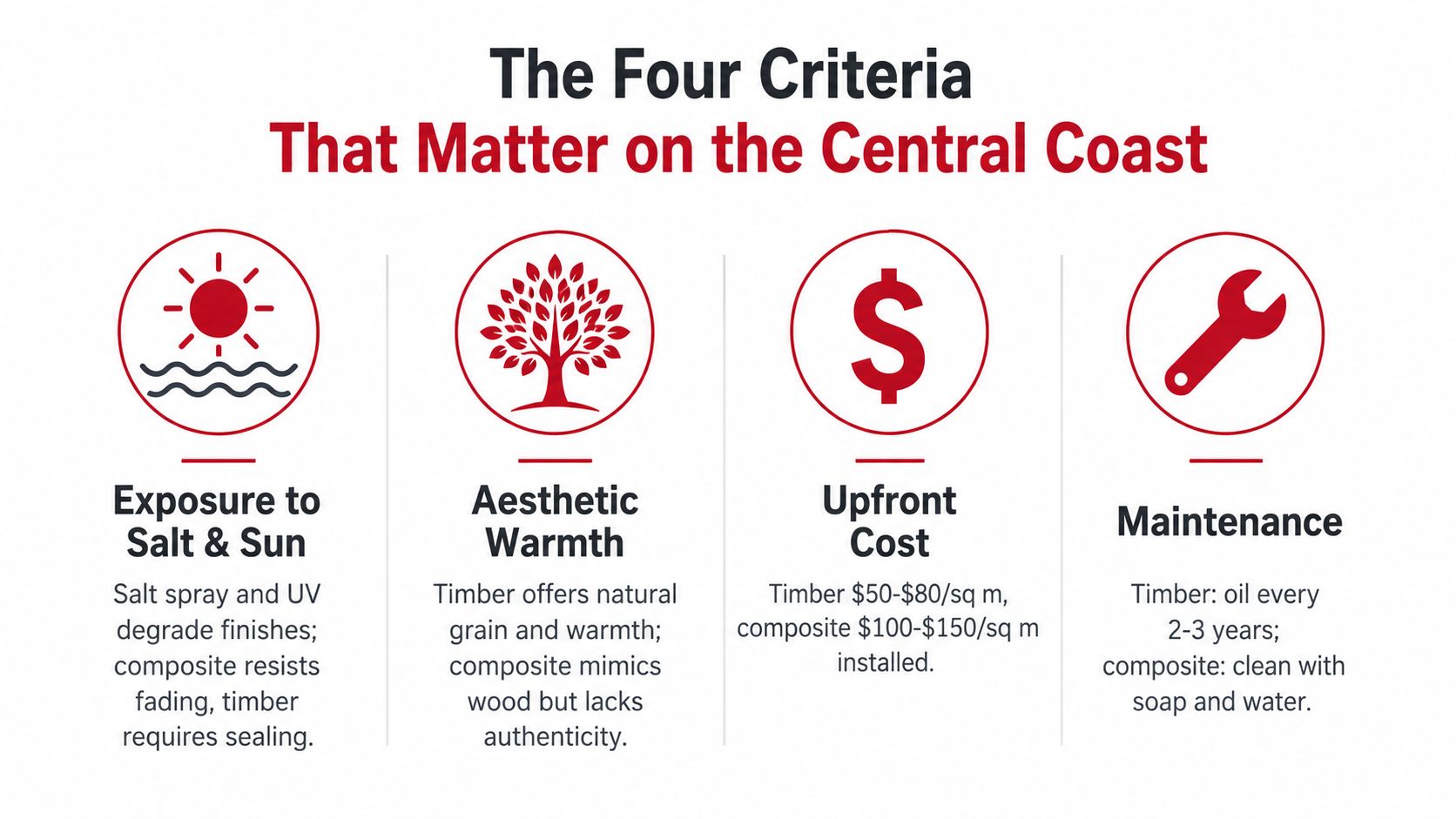
A deck on the Central Coast has to earn its keep. A place in Bateau Bay with full sun and sea spray asks for a different build than a shaded yard in Toukley near the lake, and the wrong setup will show it quickly. Material choice matters, but exposure, fixings, drainage, and installer skill decide whether the deck actually lasts.
Exposure and weather pressure
Salt air, humidity, and UV hit harder here than in a sheltered suburb inland. Timber can look superb, but if it is untreated or left poorly protected, it breaks down faster in harsher exposure zones, and the finish needs regular care to stay looking right. Composite reduces the need for oiling and repainting, but it still needs a sound subframe, good drainage, and enough ventilation so moisture does not sit underneath. If the deck sits under cover, an insulated patio roof guide is worth reading, because roof choice changes how much weather the deck copes with day to day.
Maintenance tolerance
Some households are happy to keep on top of cleaning, oiling, and checking for wear. Others want the deck to be used, not babysat. If the owner will do the upkeep, timber is a solid fit. If the goal is to spend weekends on the deck instead of maintaining it, composite is usually the smarter call.
How the deck should age
Timber changes character over time. Some owners want that silvered coastal look, others want the warm colour held for as long as possible. Composite keeps a more consistent appearance, but you cannot sand it back and rework it the way you can with timber, so the look you install is mostly the look you keep.
Lifecycle cost, not just entry price
The first quote only tells part of the story. The comparison is what the deck costs to own after years of weather, cleaning, and replacement risk are added in. That is why lifecycle thinking matters more than board price alone on the Coast, and why the structure under the boards has to be right from the start. A covered outdoor area can also change how hard the deck works through the seasons, especially where a custom Stratco patio helps manage sun and rain.
Timber Decking on the Central Coast
Timber still has a strong case, especially for homeowners who want warmth underfoot and a natural finish that suits the coast. It feels honest. It looks right beside weatherboard homes, brick homes, and the sort of relaxed entertaining spaces people use in Erina, Gosford, and Wyong.
The Australian market still leans heavily on timber-based products. A University of British Columbia literature review of residential decking material trends reported a surface-material mix of about 40% treated lumber, 26% naturally durable species, and 28% wood-plastic composites (UBC literature review). That doesn’t mean timber is automatically better, but it does show it remains a mainstream choice, not an old-fashioned one.
What timber asks from the owner
Timber asks for regular attention. Cleaning, oiling or staining, checking for raised grain, and planning for eventual sanding and recoating are part of the deal. The payoff is flexibility, because timber can be refinished and visually refreshed instead of being treated as a throwaway surface.
A family in Erina who chooses a blackbutt deck, for example, is really choosing a maintenance rhythm as much as a material. The deck can stay rich and warm if it is looked after, or it can weather naturally into a softer coastal tone if that is preferred. Either way, the owner stays involved.
Timber rewards owners who want a deck they can keep tuning over time. It punishes owners who want to ignore it.
Timber decking on the Central Coast at a glance
| Species | Relative cost | Coastal durability | Maintenance level |
|---|---|---|---|
| Treated pine | Lower entry cost | Works, but needs more care in harsher exposure | Higher |
| Blackbutt | Mid to higher | Strong choice when properly detailed | Moderate |
| Spotted gum | Mid to higher | Solid coastal option with good visual character | Moderate |
| Merbau | Mid to higher | Popular for its look, still needs regular protection | Moderate to higher |
The main trade-off is simple. Timber often wins on first impression and can be less expensive to buy at the start, but it rewards owners who are realistic about upkeep. For homeowners comparing custom decks on the Central Coast, timber suits people who want natural character and are happy to maintain it.
Composite Decking on the Central Coast
Composite is not plastic pretending to be timber. It is a manufactured board made from recycled timber fibre and polymer, and it comes in capped and uncapped forms. That blend is exactly why it became a mainstream option, because it gives a timber-like look without the same maintenance burden.
Underfoot, a good composite deck feels more uniform than natural timber. That consistency appeals to homeowners who want the space to stay neat without sanding, staining, or oiling every season. In a coastal setting, that is a serious advantage.
The Australian guide figures place composite materials at about $100 to $190 per m² for materials only. DECO Australia also places composite decking material costs at about $80 to $180 per square metre and notes timber at about $80 to $140 per square metre, with timber maintenance around $10 per square metre each year and replacement sometimes needed every 5 to 10 years. Those figures vary by product and project, but the direction is clear, composite usually asks for more upfront and less later.
What composite does well, and where it needs care
Composite's strongest selling point is low maintenance. Routine cleaning is usually enough, and the manufactured outer shell is nonporous, which helps resist staining better than timber in testing guidance from Consumer Reports. That matters when food spills, wet feet, and daily use are part of the brief.
The honest drawback is that installation quality matters a lot. Composite still needs the right subframe design, drainage, and fixing method, especially on sloping or damp sites. It also has less flexibility if the owner later wants a different colour or finish.
A couple in Terrigal who wants a low-touch entertaining area would usually lean this way. They're not buying a board they can sand and rework later. They're buying a surface that stays consistent with far less effort.
Bottom line: composite is for households that want the deck to behave more like a finished outdoor floor than a material project.
When the deck needs to sit beneath cover, or under a roofline that reduces direct weathering, the surrounding structure still matters. That's why the deck choice often gets made alongside the broader outdoor area, not in isolation. A roofed entertaining zone changes how the deck performs day to day, especially when paired with insulated roofing that softens heat and rain exposure.
Maintenance Schedules and Lifecycle Costs Over Twenty Years
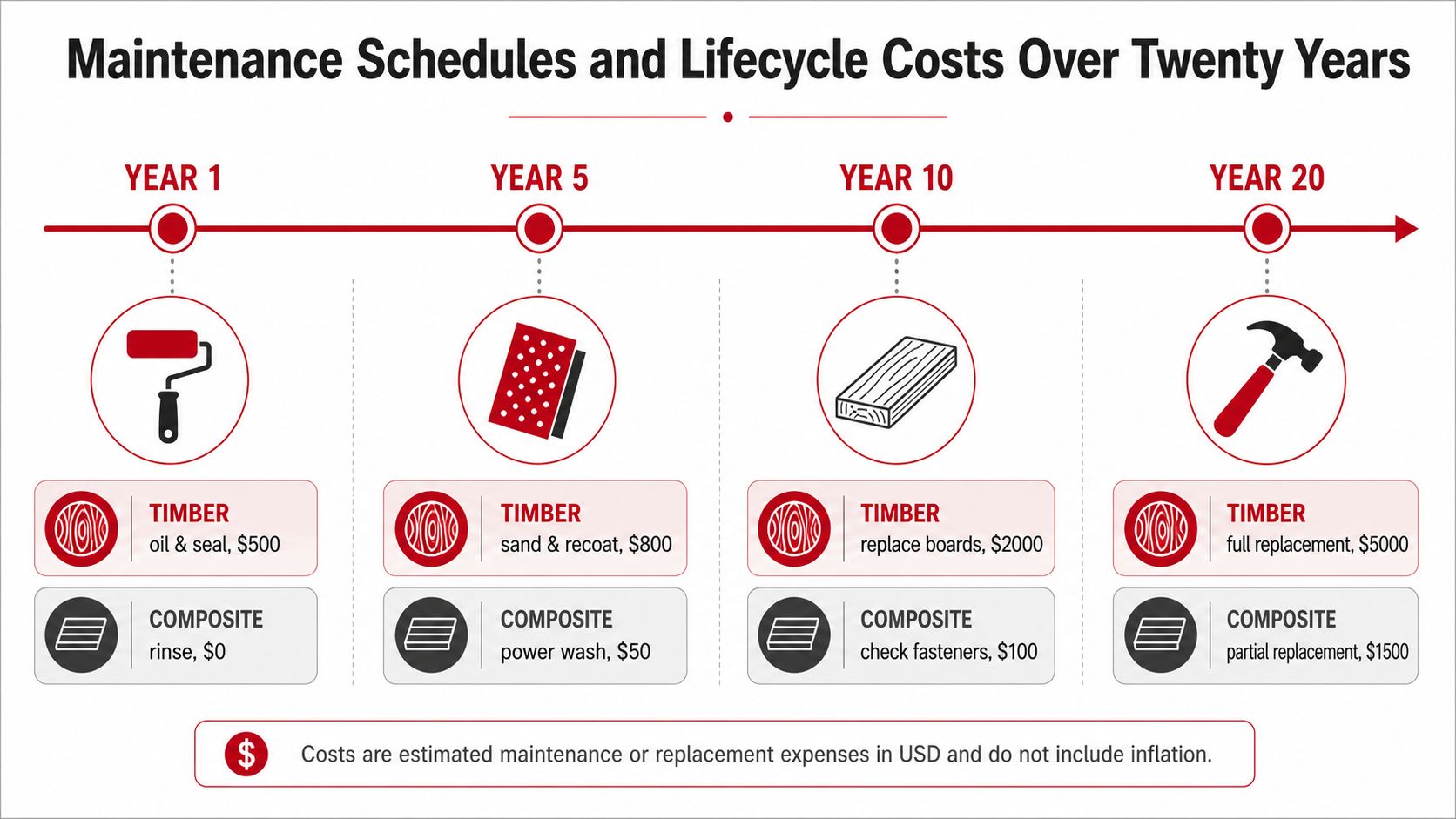
A deck's real cost shows up in the second and third year, not the first day. That is where timber and composite separate sharply. Timber asks for active upkeep, composite mostly asks for cleaning.
What each material tends to need
In year one, timber usually needs oiling or sealing if the owner wants to protect the finish. Composite usually gets a rinse and normal housekeeping. By year five, timber may need sanding and recoating, while composite often only needs a deeper clean.
The broader lifecycle picture is the point. The comparison already noted that a typical 30 m² deck can land around $11,400 to $27,400 over 20 years for timber and $6,900 to $12,900 for composite when maintenance is included. That gap is exactly why homeowners who only compare board prices can make the wrong call.
A practical maintenance rhythm
- Timber early on: clean it, protect it, and keep an eye on colour change.
- Timber over time: expect recoating and occasional board replacement if the deck sees hard use or heavy weather.
- Composite early on: rinse off dirt and let it settle into the space.
- Composite over time: keep the drainage clear and check the fixings, because the board still depends on the structure underneath.
Lifecycle assessment data also supports the same broader point from a different angle. ACQ-treated lumber used 0.23 MMBTU of total energy per representative deck-year versus 1.4 MMBTU for wood-plastic composite, with 114 lb-CO2-eq versus 330 lb-CO2-eq greenhouse impact, and a fossil-fuel burden described as equivalent to driving 38 miles a year versus 540 miles a year for WPC (Preserved Wood Council LCA). LBM Journal also cited research reporting plastic-lumber production using 14 times more energy than treated wood decking.
A handy maintenance oil resource can help timber owners understand product selection before they commit to a care routine, and one useful option is order Kingsfleet timber oil online. The product itself is only part of the story, though. The bigger win comes from choosing a finish and maintenance rhythm you'll keep up.
If a timber deck is part of a broader outdoor living area, the care plan should also cover the roof, gutters, and drainage around it. Weather management for the whole space is simpler when the structure above is designed properly, not patched together later. That is especially true in coastal conditions, where upkeep on adjoining outdoor structures matters just as much as the boards underfoot, and maintenance tips for your Stratco patio and carport in Central Coast weather are worth reading alongside any decking plan.
Matching the Material to Your Central Coast Block and Lifestyle
A sloping Wamberal block with views and salty wind is not the same job as a shaded Toukley backyard near the water. The material choice has to match the site. That is where the decision becomes practical instead of theoretical.
Four common Central Coast fits
For a sloping Wamberal block, composite often makes sense because the household wants lower maintenance, and the deck is likely to be exposed to sun and sea air. The core issue there is not just appearance, it is keeping the surface consistent without constant attention.
For a north-facing entertainer in Erina, timber can still be a smart choice if the owners like the feel of natural boards and don't mind doing upkeep. If the priority is spending weekends on the deck rather than maintaining it, composite usually wins that brief.
For a low-touch household in Wyong, composite is usually the cleaner fit. It lines up with a simpler lifestyle, a neater visual outcome, and less pressure to schedule annual maintenance around family life.
For a lakeside block in Toukley, timber can work, but the owner needs to be honest about shade, moisture, and slip management. Composite is often easier to live with where damp conditions and moss risk are part of the site.
If a homeowner wants a quick self-check, these questions usually settle the argument:
- How much sun does the deck cop?
- How much time will be spent on maintenance?
- Is the block north-facing, shaded, or exposed to wind and salt?
- Does the home need a material that can be refinished later, or one that stays more consistent?
- Is the deck part of a future sale plan, or a long-term family space?
A deck choice is often clearer after looking at another outdoor surface that has already been through the approval and install process. A homeowner comparing preparation and finish work on timber or masonry can learn a lot from Auckland fence prep tips, even if the project is different. The lesson is the same, prep and installation detail decide how long the finish really lasts.
Approvals, Quotes and What to Ask Your Installer
A good decking job starts with the paperwork, not the saw. On the Central Coast, the path can be exempt development, complying development, or a development application, and the current rules should always be checked through the NSW Planning Portal or the local council before work starts. Rules change, sites vary, and the approval path depends on the size, height, boundary setbacks, and the property itself.
What the installer should be able to show
A proper deck quote should spell out the structure, the fixings, drainage, removal of any old material, and the finish. It should also explain what is excluded, so there are no mid-project surprises. Coastal sites need hardware and detailing suited to the environment, not generic kit logic.
Ask for the build method in writing, not just the price. The quote should make it obvious how the deck handles water, movement, and wind.
Professional installation usually beats DIY on the Coast because the subframe and drainage matter as much as the boards. That is especially true on sloping sites or where the deck meets a patio, pool area, or another outdoor structure. Fixed-fee quotes are the right model here, because homeowners need certainty before work starts.
A useful checklist for any installer is simple:
- Engineered drawings: are they included?
- Coastal fixings: are they specified for the environment?
- Drainage and subframe: is that explained clearly?
- Warranty paperwork: is it handed over in writing?
- Scope clarity: does the quote say exactly what is and isn't included?
Where a deck sits alongside a patio or pergola, the whole outdoor area should be designed as one system. That is often the difference between a space that handles the weather and one that fights it. A well-planned outdoor area also leaves room for why to choose an authorised Stratco dealer on the Central Coast if the broader project includes covered structure work.
Common Questions and Next Steps
A Central Coast homeowner usually ends up asking the same handful of questions once the deck is on the table. The right answer depends on salt air, sun exposure, and whether the build is done properly from the start.
How long does timber decking last on the Central Coast?
It comes down to species, exposure, and maintenance. Salt air, strong sun, and regular moisture punish timber that is left unprotected, while a deck that is cleaned, sealed, and repaired as needed can stay in service for much longer. There is no honest single lifespan to hang your hat on. The key question is whether the owner will keep up with protection and replace tired boards before small issues spread.
How long does composite decking last here?
Composite usually delivers a longer low-maintenance run because it does not need the same oiling or staining cycle as timber. That advantage only holds if the subframe, drainage, and fixing details are right. Get those wrong and the boards will still fail early, no matter what the brochure says.
Does composite get too hot in north-facing sun?
Yes, it can. Dark colours and full sun make a difference, and open decks on exposed blocks feel it more than shaded ones. Timber also gets warm, so the comfort result usually comes down to orientation, shade, and whether the deck sits under a roof or out in the open.
Does timber add more resale value than composite?
No automatic answer there. Buyers notice condition, appearance, and how easy the space is to live with. A neat, well-built deck helps more than the material label on the board.
What is the total project range when structure, balustrade, and stairs are included?
There is no honest single number without seeing the block. Height, access, structure, and finish choices all shape the final figure, which is why a fixed-fee on-site quote is the only sensible way to price the job properly.
Should a homeowner pick timber or composite first?
Start with the maintenance lifestyle, then choose the board that suits it. That is the cleanest way to avoid regret later.
Outdoor Leisure Living is the Central Coast's authorised Stratco and Stratco Outback dealer: family owned, over a decade in business with more than 35 years of industry experience, and 75+ five-star reviews across the Central Coast and Lake Macquarie.
If the deck is part of a bigger outdoor plan, the whole space should be designed together, not patched together one product at a time. Outdoor Leisure Living can help homeowners weigh timber vs composite decking alongside the roofline, approvals, and finish details that matter in coastal NSW. Visit Outdoor Leisure Living to organise a free on-site design consultation and get a fixed-fee quote that suits the block, the budget, and the way the space will be used.