


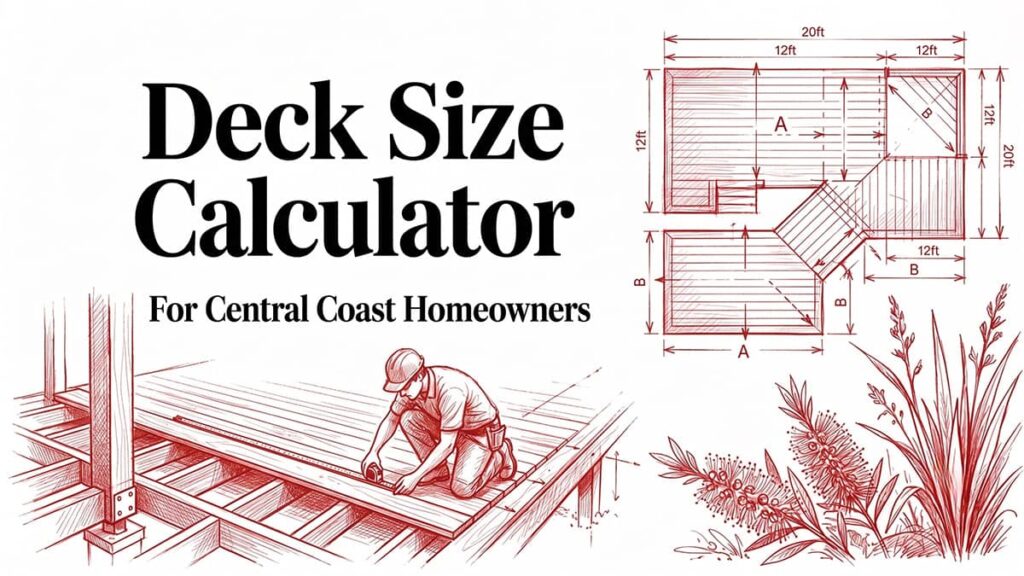
Picture the deck before it exists. The barbecue in the corner, the table where Sunday lunch stretches into the afternoon, bare feet on warm boards. Before any of that can happen, one question has to be answered: how big does it actually need to be? Use the free calculator below to work out your deck area in square metres, plus the lineal metres and number of decking boards a deck that size would need.
It takes less than a minute, and it works for rectangles, L-shapes and odd multi-level layouts. If you would rather have someone measure it properly, the team behind our custom-built decks on the Central Coast does exactly that, for free, on your block.
Deck Size & Decking Board Calculator
Work out your deck area in square metres, plus the lineal metres and number of boards needed.
1 Choose your deck shape
2 Enter your dimensions (metres)
3 Decking board details
Typical wastage: 10% for simple rectangles, 15% for L-shapes, diagonal laying or picture framing.
Please enter dimensions greater than zero for your chosen shape.
Your estimated deck size
These figures are estimates only. Board coverage, joist layout, fixings, steps and site conditions all affect the final quantities, and every block is a little different.
Want exact numbers for your block? Book your free on-site design consultation. Call 0494 571 131.
The short answer
To calculate deck square metres, multiply length by width in metres. A 6 m x 4 m deck is 24 square metres. For an L-shape or odd shape, split it into rectangles, calculate each one, and add them together. Most Central Coast decks land somewhere between 15 and 40 square metres, with 20 to 30 square metres the sweet spot for a family entertaining area.
How to measure your deck area by hand
1. Rectangular decks
The easy one. Measure the length and width in metres and multiply them. Measure in metres from the start (a 5,400 mm wall is 5.4 m) so you are not converting later.
2. L-shaped and wraparound decks
Break the shape into two rectangles: the main run and the return. Calculate each and add them. A 6 m x 4 m main deck with a 3 m x 2 m return is 24 + 6 = 30 square metres. The same trick handles wraparound verandahs; they are just three or four rectangles joined together.
3. Split-level and odd shapes
Treat every level or section as its own rectangle and total them up. If a corner is clipped at 45 degrees, it is usually fine to measure it as a full rectangle at this stage. The small overlap becomes part of your wastage allowance, and it is better to estimate slightly over than slightly under.
From square metres to decking boards
Area tells you the size of the deck. Boards are where estimates usually go wrong, because two extra factors sneak in.
The gap between boards. Decking boards are laid with a small gap, typically 3 to 5 mm, so water drains and timber can move with the seasons. That gap means each board covers slightly more width than the board itself. A 137 mm composite board with a 4 mm gap covers 141 mm per row, and the calculator uses this combined figure to work out lineal metres.
Wastage. Offcuts, docking ends square, damaged boards and awkward corners all eat material. Allow around 10% wastage on a simple rectangle and closer to 15% for L-shapes, diagonal laying patterns or picture-framed edges. Running short of boards mid-job is far more painful than having a few spare lengths.
As a worked example: a 24 square metre deck in 137 mm boards with a 4 mm gap needs about 170 lineal metres of decking before wastage, or roughly 187 lineal metres with 10% added. In 4.8 m stock lengths, that is about 39 boards.
Why deck size matters more than you might think
Size can decide your approval pathway
In NSW, small low-set decks can sometimes be built as exempt development, with no approval needed, provided they stay under strict size and height limits (commonly cited as up to 25 square metres and less than 1 m above ground, among other conditions) [VERIFY current NSW exempt development limits before publishing]. Go bigger or higher and you may need a complying development certificate or a development application through Central Coast Council or Lake Macquarie City Council. Knowing your square metres early tells you which conversation you are having.
Size drives structure
A bigger deck is not just more boards. Spans, joist spacing, bearer sizes and footing numbers all scale with area and height, and decks above 1 m generally need a balustrade [VERIFY balustrade height trigger]. This is where a designed-and-installed deck earns its keep over a guess.
Size shapes how the space gets used
A 6-seat outdoor dining setting wants around 10 square metres once you allow room to pull chairs out. A barbecue with prep space wants another 4. If the calculator says your planned deck is 16 square metres and your wish list adds up to 20, better to find out now, on paper, than after handover.
Timber, composite or steel-framed?
Deck size also influences material choice. Larger decks magnify the maintenance difference between timber (oiling every year or two) and composite (a wash now and then), and steel framing comes into its own on sloping or coastal blocks where longevity matters. Outdoor Leisure Living builds all three, custom designed for your block, with a 10-year warranty.
Frequently asked questions
How do I calculate deck square metres? Multiply length by width in metres. For odd shapes, split the deck into rectangles, calculate each, and add them together.
How many decking boards do I need per square metre? It depends on board width. With 137 mm boards and a 4 mm gap, allow roughly 7.1 lineal metres per square metre before wastage. Narrow 86 mm boards need closer to 11 lineal metres per square metre.
What is a good size for a family deck? Around 20 to 30 square metres suits most families: enough for a 6-seat dining setting, a barbecue and room to move. Smaller decks work well as landings or morning coffee spots.
Do I need council approval for a deck in NSW? Not always. Small, low decks may qualify as exempt development, but size, height, boundary setbacks and your property zoning all matter [VERIFY]. Outdoor Leisure Living can guide you through the approval question during your free consultation.
Should I round my measurements up or down? Up, always. A slightly generous estimate covers wastage and small measuring errors. Running out of boards mid-build means delays and sometimes mismatched batches.
Does the calculator include stairs and handrails? No. Treat stair treads as extra lineal metres and price balustrades separately. Your on-site consultation will capture both.
Get your exact deck size, measured on your block
The calculator gives you a solid starting point. The final answer comes from your block: the slope, the sun, the doors it connects to and the way your family will actually use it.
Outdoor Leisure Living is the Central Coast’s authorised Stratco and Stratco Outback dealer: family owned, over a decade in business with more than 35 years of industry experience, and 75+ five-star reviews across the Central Coast and Lake Macquarie.
From there, we design and build timber, composite and steel-framed decks across the Central Coast and Lake Macquarie, custom sized to fit your home and backed by a 10-year warranty.
Book your free on-site design consultation. Call 0494 571 131.